Archives

Going Gentle Into That Good Night – The Book is a finalist in the SeniorHomes.com Best Senior Living Awards 2014

Thank all of you who have voted so far for my book, Going Gentle Into That Good Night BookI wanted to pass what I learned on, so I wrote Going Gentle Into That Good Night .

It’s a finalist in the SeniorHomes.com Best Senior Living Awards 2014 books categories.

A panel of judges will determine the SeniorHomes.com expert winner, but your votes will determine the People’s Choice winner. Voting is open until May 12, 2014. So, if you haven’t had a chance to vote yet, I’d certainly appreciate you doing some research into my book and giving me a vote if you think it’s a good offering in this category.

Going Gentle Into That Good Night – the book – is a finalist in the SeniorHomes.com Best Senior Living Awards 2014.

Going Gentle Into That Good Night – the blog is a finalist in the SeniorHomes.com Best Senior Living Awards 2014

And my blog – “Going Gentle Into That Good Night” (http://atomic-temporary-53681440.wpcomstaging.com) – is a finalist too. 

Once again, I thank everyone who has voted and ask anyone on my friends’ list who hasn’t to at least take a look at the blog (http://atomic-temporary-53681440.wpcomstaging.com).

Even if you don’t need this information personally, someone you know – a friend, a family member, or a colleague – needs it.

Everyone – and that includes all of us – even if not right here, right now, will be touched personally by the issues of dementias, Alzheimer’s Disease, and caregiving.

I have been through it personally. This blog is not an academic exercise. 

It is not, like a lot of the dementias and Alzheimer’s Disease blogs that post incessantly on a daily basis, an impersonal web bot scouring of the internet for things that might be related.It is not the sanitized and sterile posts that you’ll find on the “official” dementias and Alzheimer’s Disease web sites.

Instead, you’ll find real-world, understandable, and practical information AND solutions about these diseases. I talk about topics that no one else talks about – do a search on “lifestyle dementia” on my blog and you find information you need even if dementia and Alzheimer’s Disease has never entered into nor been a part of your personal experience – because I want to make sure everyone is educated about the many factors that can and are leading to this burgeoning neurological epidemic.

Going Gentle Into That Good Night is a finalist in the SeniorHomes.com Best Senior Living Awards 2014
.

The Rare Dementias: Progressive Supranuclear Palsy

This post will begin a continuing series of posts that looks at rare types of dementia. Today’s post will look at the dementia of Progressive Supranuclear Palsy.

Since this blog is primarily original and unique content that provides real education and real resources and understandable information that you can actually use (you’ve no doubt noticed that, unlike many of the blogs that purport to “talk” about Alzheimer’s Disease and dementias, Going Gentle Into That Good Night does not flood your email each day with many, many blog posts that are either old news, political advocacy, or simply forwarded items from some other source, but instead does the medical and scientific research and translates that into usable and practical information for you), I  will provide a clarification that I often do here.

Too many times, I hear the term “Alzheimer’s Disease” used to characterize any and all neurological damage, decline, and death.

That characterization is wrong. 

Dementias refer to the full category of unique terminal neurological diseases that result in irreparable damage and destruction in the brain that lead to cognitive impairment, cognitive decline, and are always ultimately fatal. 

Alzheimer’s Disease is one type of dementia. However, not everyone who suffers from dementia has Alzheimer’s Disease. And sometimes people who suffer with dementia have more than one type of dementia happening concurrently (these are called mixed dementia diagnoses). 

I’ve had people who’ve never dealt directly with dementias kind of wave me off with a “whatever!” reaction when I correct them on this. And I understand that if someone hasn’t had to deal with these dementias day in and day out, they really don’t know and it doesn’t seem like a big deal.

However, for those of us who are dealing with it day and day out – or who may be in the future dealing with it day in and day out – it’s a really big deal.

Why? Precision in defining and understanding the types of dementia is absolutely critical both in caring for our loved ones, but also in effectively addressing the symptoms and behaviors associated with each dementia.

I’ll explain this in an analogy.

Let’s say you or I got diagnosed today with hypertension (high blood pressure). The normal pharmacological treatment is a medication to lower the blood pressure and possibly statins or beta channel blockers to supplement the efficacy of the main medication.

Your physician gives you the diagnosis of hypertension followed by the statement “it’s about the same thing as cancer,” and then sends you to the local hospital for radiation treatment, to be followed by chemotherapy.

Absurd, right? And yet while this may be obviously absurd to nearly everybody, a lot of those people don’t make the connection to the same absurdity of classifying all dementias as a single type of dementia.

But this underscores why it’s just as important to know about the different types of dementias and how to address and respond to the unique areas of the brain they affect as it is to know that you don’t treat hypertension with radiation and chemotherapy.

I have full-information posts on this blog about some of the more common types of dementias and symptoms/behavioral treatments:

And that’s why I want to cover some of the rarer types of dementia now. There’s no substitute for education.

We’re all, if we haven’t already been, going to be personally effected by these diseases at some point in our lives.

We can either be knowledgeable or we can spend time that we should be focusing on our loved ones playing catch-up because we didn’t take advantage of this opportunity to learn about these neurological diseases now.

Progressive supranuclear palsy (also known as Steele-Richardson-Olszewsky syndrome) is a rare neurological disease that, over time, irreversibly damages neurological cells, primarily in the brain stem, causing a severe degradation of gait, balance, complex eye movements, and thinking.

Because gait and balance are primary symptoms of progressive supranuclear palsy, this neurological disease is often misdiagnosed as Parkinson’s Disease. However, progressive supranuclear palsy has unique characteristics that differentiate it from Parkinson’s Disease.

brain-stem-progressive-supranuclear-palsy

The brain stem handles many of the critical functions of the body, including eye and mouth movement, balance, breathing, consciousness, swallowing, sensitivity to external conditions (heat, cold, pain, pleasure, etc.), and hunger. 

The earliest symptoms to emerge with progressive supranuclear palsy are with gait and balance, leading to unexplained falls. Frequently the falls are described by those experiencing them as sudden attacks of dizziness.

Other early symptoms include marked personality changes, including apathy, increased irritability, increased aggravation, inexplicable angry outbursts, and increased forgetfulness.

As progressive supranuclear palsy advances, the characteristics that distinguish it from Parkinson’s Disease begin to appear in vision problems.

The first two vision problems to materialize are blurry vision and difficulty controlling eye movement. It is usually when these symptoms appear that progressive supranuclear palsy can be accurately diagnosed.

People suffering with this neurological disease will, by this point in the disease process, experience severe difficulty voluntarily shifting their eyes to a downward gaze and in controlling their eyelid movements. 

This lack of control over eye movement can result in exaggerated or infrequent blinking (infrequent blinking can cause serious damage to the eyes including severe dryness and ulcers on the surface of the eye) and not being able to close the eyelids or to open the eyelids.

As these symptoms appear, other symptoms also emerge. These include increasingly slurred speech and frequent difficulty in swallowing solid food and liquids (dysphagia).

There are currently no definitive treatments for progressive supranuclear palsy.

There is some research that has shown botulinum injections (Botox) can be an effective treatment for the involuntary eye movements associated with this neurological disease. However, Botox carries its own risks and the benefits of using this as a potential therapy must be weighed against those.

The normal treatment for gait and balance problems – medication and physical therapy – have, to-date, proven ineffective. Therefore, sufferers of progressive supranuclear palsy must use weighted walkers and must have human assistance when walking. Eventually, the problems become severe enough and safety becomes a high enough concern that people suffering from progressive supranuclear palsy are confined to wheelchairs.

The symptom of dysphagia is the most dangerous and the most likely to have a fatal outcome. This is because of choking and the high likelihood of aspirating food back into the lungs. Aspiration often leads to pneumonia, and in this class of neurological diseases, pneumonia is very often fatal.

The only way to address this aspect of progressive supranuclear palsy is to change to the texture of the food. The National Dysphagia Diet Levels is the standard progressive list used to determine food consistency levels as dysphagia worsens.

However, at some point, all ability to swallow anything will be lost, so even if pneumonia is avoided or successfully treated, the time will come when people suffering from progressive supranuclear palsy will not be able to take any kind of nourishment or hydration. This, then, would be the other eventual cause of death from this neurological disease.

New Book: “You Oughta Know: Recognizing, Acknowledging, and Responding to the Steps in the Journey Through Dementias and Alzheimer’s Disease”

I’ve just written and published my newest book, You Oughta Know: Recognizing, Acknowledging, and Responding to the Steps in the Journey Through Dementias and Alzheimer’s Disease.

It is available in both paperback and Kindle versions.

I’ll include the short summary from Amazon I wrote for the book:

You Oughta Know: Recognizing, Acknowledging, and Responding to the Steps in the Journey Through Dementias and Alzheimer's Disease“This book looks comprehensively at all the steps that occur in dementias and Alzheimer’s Disease.

In my own experience with this and in counseling, supporting, and working with others who are going through these steps, I realized there is a basic lack of comprehension about the big picture of how these neurological diseases progress.

I know that because the same questions get asked and answered over and over again.

My purpose is to ask those questions and answer them in a way that, first, makes sense, and, second, works for everybody involved.

I know. I’ve been on the caregiving side of the equation personally. There were no books like this when I did it, so I had to learn on my own and figure out what worked and what didn’t. I made mistakes. You’ll make mistakes.

But, in the end, my mom and whoever you love and are caring for, got the best we have to give and we can learn some pretty incredible and good life lessons along the way.

If you don’t read another book on this subject, you should read this one. I don’t have all the answers, but the answers I have learned are the ones that probably matter most.

Not just now, but for the rest of our lives.” 

This book also includes the last step that we take alone without our loved ones: grief. I’ve been there and I’ve done that and although I will never not feel the grief on some level, I’ve learned some lessons that I know will help each of you.

If You Needed Help, Does Anyone Have What They Need From You to Step Up to the Plate?

Kay Bransford and I seem to be on the same page a lot these days, but I see that we seem to be the only ones willing to tackle these subjects, so I guess we will keep sounding the drums that all of us need to be preparing in advance for the possibility that something – whether it’s Alzheimer’s Disease, dementias, other life-threatening illnesses, or simply time and chance – could suddenly and dramatically or slowly and insidiously render us incapable of taking care of our own affairs.

It seems to me that the very thing we try most to avoid thinking about, talking about, planning for is the very thing that will eventually happen to us all. And that is death.

Denial is, in my opinion, stronger and more pervasive in this area of life than in any other. “If I don’t think about it, then it isn’t real” seems to be the underlying thinking of this denial. I’m here to tell you that all the denial in the world won’t take away its inevitability of happening.

None of us, except those who chose to usurp God’s will and end their own lives, know how or when we’re going to die.

I believe most of us assume it will be quick and instantaneously, but the reality is that, in all likelihood, most of us will probably have a period of decline in which we will need help handling our financial, legal, and medical affairs before we take our last breaths.

And, after we take our last breaths, someone will have to take care of getting us buried and ending our financial, legal, and medical status among the living.

Who would that be for you? Yes, you, the one who is reading this post. Do you know? Does that person know? If that person knows, have you made this as easy as possible for him or her by doing your part and making sure he or she has everything he or she needs to do what needs to be done?

Or, because you don’t want to think about it or talk about, will that person have the burdensome responsibility of trying to figure it out all on his or her own?

We say we don’t want to be burdens to our loved ones. By taking care of this, you and I – we – have taken a big step toward easing the magnitude of that burden that, if we live long enough, will be shouldered by our loved ones.

I did my first will and living will shortly after I turned 21. I had just graduated from college, but not before having a very serious car accident (one that I miraculously survived with some significant injuries, but nothing like what I should have suffered) just before I graduated.

I’d never been that close to being face-to-face with death before, but it made me realize that I needed to make sure that my affairs – and they were paltry in those days but even then I had life insurance – were in order for the ones I’d leave behind.

From that point on, I have been meticulous about keeping my will up-to-date, the beneficiaries on my insurance policies up-to-date, and all the information my executor will need to take care of things up-to-date. I added a DNR to my medical wishes about 20 years ago, I got my cemetery plot 15 years ago, and I wrote out my funeral service and burial wishes about 10 years ago. 

Additionally, my executor has updated access and account information to everything online and offline to finish up my earthly affairs when I’m gone.

preparation-death-alzheimer's-disease-dementias-age-related-illnessesThis, in my opinion, is the last act of kindness I can do in this physical life. It is also one of the greatest.

Mama used to worry that something would happen to me (i.e., that I would die before she did) and then about what would happen to her. There were times in our lives together that could have been a possibility, but I always reassured her that I’d be there with her to the end. And I was by the grace of God.

Of my parents, Daddy was a paradox when it came to this subject. On the one hand, he had life insurance that would take care of Mama after his death and he insisted, in the year before his death, that Mama get her own checking and savings accounts and get credit cards in her name only.

On the other hand, there were other areas in which he had great difficulty facing his mortality. I remember Mama suggesting that they start getting rid of clothes and other things they weren’t wearing or using anymore and Daddy’s response: “the girls can take care of that.”

The will that Daddy had in effect, until shortly before his death, was the one that he had drawn up just after he and Mama adopted us. None of the information was pertinent or relevant anymore.

After much and extended (I’m talking a couple of years) discussion between Mama and him, they finally went to a lawyer, about six weeks before he died, to have a current will drawn up.

Mama was just the opposite. Somehow, I think all the deaths of close and beloved relatives in her early years made the inevitability of death more real to her. She, primarily, during our growing up years, talked on a regular basis about what would happen to us if she and Daddy died and how we needed to take care of each other and be good kids so the road without them would be easier for us.

Not long after Daddy died, she and I sat down together (I was now checking in daily and helping her navigate through some of the things that Daddy had done and offering advice and assistance as she needed it) and she told me what she wanted – and didn’t want – as far as end-of-life wishes.

We went to an attorney together and she did a will (which she later changed to a revocable living trust), living will, and all the POA paperwork. I had copies, she had copies, and she put copies in a safety deposit box at the bank.

At that time, I didn’t need or want knowledge or access to her financial accounts, but as time went on, she needed more of my help in dealing with them, so she gave me access to get into the accounts and help her (we always sat down and did this together until she wasn’t able to anymore) keep up with bills and what she had. 

By doing this with me, Mama made things much easier for me when the time came that I had to step in because she couldn’t do it.

I can’t thank Mama enough for her foresight with this gift. Instead of having to focus on everything brand new coming at me at once, I could focus on what was most important, and that was Mama: loving her, caring for her, being there for her.

The last couple of months Mama was alive, we’d be sitting close, holding hands, and talking and suddenly she’d say “I don’t want be a burden on you,” with tears rolling down her cheeks. I’d squeeze her hands and pull her closer in a hug, kissing the tears away from her cheeks, saying, “Mama, you’re not a burden to me. I love you unconditionally. I wouldn’t be anywhere else doing anything else but right here doing this with you.”

Mama would relax in my embrace and I would hold her tighter as I said these words because they were true and we both recognized that they were true, but most of all, I recognized how easy Mama had made things for me by equipping me with what I needed to step in easily and take care of the routine things so that I could save my energy, my focus, and my love for taking care of her.

In God’s Country: Northeast Tennessee and Mama

This is a remembrance of Mama (written at the blog I created for the memoir I wrote about our family), who would have been 85 today. She fought with strength, dignity, and bravely in all the journeys of her life – including vascular dementia, Lewy Body dementia, Alzheimer’s Disease, and congestive heart failure – and left an example showing us, her kids and grandkids, how to walk and endure our own journeys. Miss my mama and love her dearly. ♥

fieldsofgoldbk's avatarFields of Gold: A Love Story - The Book

Eighty-five years ago today, about nine months before the Great Depression began, in Flag Pond, Tennessee, Muriel Foster Ross – my mama – was born to Samuel and Ennis Foster.

A doctor and both grandmothers were there attending the long and arduous birth that was taking a fatal toll on Mama’s mother and led the doctor, upon delivery, to dismissively say “that baby’s going to die” as he handed an underweight and frail Mama to her paternal grandmother, Grandma Foster, and turned his attention to trying to save Ennis Foster’s life.

Grandma Foster countered, “This baby’s going to live!,” and put Mama in the warming bin of the oven in the kitchen – a primitive incubator. Grandma Foster hovered over Mama through that afternoon and night, feeding her and wrapping her up in fresh towels every few hours.

By the next morning, Mama was stronger, had color, and it was…

View original post 1,154 more words

“To Sleep; Perchance to Dream:” Dream Research That Could Provide Insights Into R.E.M. Sleep Behavior Disorder and Lewy Body Dementia

There seems to be a lot of current effort going into researching into what happens neurologically while we sleep.

what-dreams-may-comeHowever, this article from Huffington Post that lists nine facts about dreams caught my interest, especially in light of my experience with my mom’s Lewy Body dementia and R.E.M. sleep behavior disorder.

I think this research could give some good insights into this particular facet of Lewy Body dementia, which always fascinated me and intrigued me to watch and listen to when Mama was experiencing it.

The last movie Natalie Wood made before her death in 1981 was a forgettable movie, despite a high-profile cast that included Christopher Walken (who has the creepy eyes of a villain, no matter what character he’s playing) and Louise Fletcher, called Brainstorm.

The movie is about a bunch of scientists who are trying to develop a device that will record everything happening in someone’s brain so that someone else can fully experience the same thing right down to the emotions and physical sensations (much like the virtual reality simulators we have today).

Louise Fletcher’s character is wearing the device when she experiences a fatal heart attack and all her brain activity is recorded.

After her death, Christopher Walken’s character uses the device to walk through Fletcher’s last minutes on earth, but almost dies in the process because he experiences the sensation of a fatal heart attack just like she did. The scientists decide the device is too dangerous and the project is scrapped.

While the movie was awful, the subject was fascinating because neurology is still so incomprehensible for the most part and unlocking all its secrets are, in my opinion, truly beyond the grasp of humans.

So any time we’re able to get just a sliver of a glimpse into how the brain works, it’s another piece of the puzzle, which we’ll never finish, that we can put into place.

There are some facts from the Huffington Post article about dreams that I found interesting, and may be a slightly-ajar door into understanding R.E.M. behavior disorder.

Our bodies react to dreams the same way they would if we were awake and experiencing those things and we dream in real time.

R.E.M. behavior disorder shows us that because we hear it and see it external in speech and motion and there’s a general sense of what’s going on the dream just by what our loved ones are saying and doing.

And as someone who dreams vividly most of the time, I can also attest that this is true.

If I’m falling in my dreams/nightmares (a little more on nightmares later), I literally feel the sensation of falling, which is what jolts me awake. All the fear in the dreams/nightmares is evidenced by my greatly-accelerated heart rate, profuse perspiration, and a long exhalation of breath that I began to hold just before I woke up.

The same thing happens when I’m running (these are my two default nightmares) away from something that’s either dangerous or chasing me. I jolt awake. My legs are tired, I am struggling to catch my breath, and I turn on a light to make sure nothing and nobody is there that I need to run from. All that happens in perhaps a second.

But the next fact about dreams that is fascinating comes into play here. I can’t go back to sleep because I am literally replaying the dreams/nightmares – I do this with other dreams, especially the ones that have meshed people and places and things that don’t belong together in them – too when I wake up and I can see them and go through them awake to try make sense of them or figure out why I dreamed them – almost frame-by-frame.

And there is a cadre of dreams and nightmares I’ve had over my lifetime that I recall just as vividly and in detail right now – I see them in my mind’s eye, if you will – as when I first had them, some of which go all the way back into early childhood.
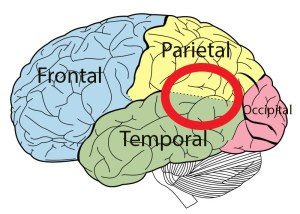
temporoparietal-junction-rem-behavior-disorder-lewy-body-dementiaResearch has found that people who can recall their dreams regularly have a higher level of spontaneous activity, both in sleep and in wakefulness, in the medial prefrontal cortex and the temporoparietal junction of the brain than those who seldom remember their dreams. 

The temporoparietal junction of the brain is a key player in processing both information from within the body as well as external information, while the medial prefrontal cortex is responsible, in part, for cognition (strategy, decision, actions) in environments where uncertainty (awake or asleep) exists.

Alzheimer’s Disease research shows a greatly-reduced metabolism rate in the temporoparietal junction in general and it appears that all types of dementia affect the medial prefrontal cortex.

One of the primary areas where medial prefrontal cortex research has been done is in PTSD and there is strong evidence to suggest that PTSD is the result of neurological changes within the medial prefrontal cortex.

It would, therefore, probably not be surprising to see a higher incidence of dementias and Alzheimer’s Disease eventually occur within people who have been diagnosed with PTSD.

medial-prefrontal-cortex-rem-sleep-behavior-disorderMy thinking, though, of the higher activity in the temporoparietal junction and medial prefrontal cortex in those of us who usually can recall our dreams, is that it’s actually hypersensitivity of both of these parts of the brain, because research also shows a high sensitivity to sounds when “high recallers” are awake.

I am definitely much more sensitive to sounds, both in frequency, pitch, and patterns, than most people, to the point that they really bother me or I can’t be around them very long because they literally hurt (I can’t exactly explain that in tangible terms, but I experience an almost-unbearable intense sensation of both auditory and neurological pain).

Sudden sounds, whether they’re loud or not, make me jump. Extended exposure to high-volume sounds makes me physically uncomfortable. And a lot of sounds occurring simultaneously overwhelms me.

The impact of this particular research for our loved ones suffering from Lewy Body dementia and R.E.M. behavior disorder, because they do not remember their dreams at all, could lead to a closer look at the medial prefrontal cortex and temporoparietal junction regions of the brain and the role that Lewy Body proteins play in how they function.

A third fact in the Huffington Post article that I found intriguing is that nightmares aren’t always about fear, but other underlying emotions like failure, worry, sadness, or guilt. My guess is that we morph all those other emotions into whatever foundational emotion underlies all of them.

I believe that underlying emotion is the primary emotion we’re most familiar with, understand the best, and either know how to escape (in my case, running) or know it is what will finally do us in (in my case, falling off something high enough that it will kill me, usually the road or bridge that turns into a high-wire I realize I’m on over the middle of the stormy waves of an ocean with no way to get to either end safely and I look down, lose my balance, and start falling).

The last fact I’ll discuss about dreams surprised me because I’ve never heard anyone say this out loud, although I’ve experienced it. You can die in your dreams and live to tell about it.

I never died in my dreams, always waking up before inevitable death, until I was in my late 20’s.

I clearly remember my first dying dream and the sensation of knowing I was dying and then actually, in what seemed like slow motion, going through the process of dying.

How I died was not the way I would ever die in real life, but what I remember most was that once I realized I was dying, it wasn’t scary. In fact, it was, although what killed me was extremely violent, peaceful and easy, with the last sensation I had being one of relief. 

I’ve died on a regular basis in my dreams since then, but the most striking similarities among these dying dreams are that they aren’t scary and there is a profound sense of relief before it all just fades to black.

I suspect because death has been on the doorstep of my life – not me personally, but with my dad first and then my mom – since my late 20’s, the dying dreams are my way of coping with that.

I also suspect that because they haven’t been traumatic experiences for me, they equipped me to better handle the dying processes of both my parents.

And they’ll continue to equip me to handle well the inevitable conclusion to my own life whenever and however it comes.

After all, dreams are just another part of the incredible, albeit mostly out of the reach of humans, complex neurological system of reasoning, thinking, understanding, and responding that our Creator endowed us with. 

Where are you? stings more now

Early on in Mama’s dementias and Alzheimer’s Disease – as I was grappling with understanding and accepting what was happening to her mind – it occurred to me that all humans go through an initial incline, a longer period of plateau, and then a final decline.

The decline mimics childhood in reverse, until if we live long enough we end up being like a newborn, totally helpless, totally dependent, unable to express ourselves except through the most primal language we humans have: laughter and tears.

I always told Mama that I’d do everything possible to make sure her second childhood was better than her first one. I did my best, making mistakes along the way (just like there are no instruction manuals for the day-in, day-out parenting of a child, there are no instruction manuals for becoming a parent to your parent, so you learn as you go), but assured that the one place I did not fail Mama was in making sure she knew she was loved, she was wanted, and I wasn’t going to leave her.

My hope is that in our simultaneous and shared journey of her taking two steps back and one step up and me taking two steps up and one step back that, in the end, my love, my care, my concern, my devotion, and my commitment was enough to make up for all the things I didn’t know, didn’t understand, and sometimes screwed up because of my own ignorance and ineptness.

This is not a journey for the faint-hearted. Once committed, even though no one ever really knows what they’re getting into, it requires a lot of tenacity and a lot of prayer. But it also requires unconditional love, abundant mercy, infinite patience, persistent gentleness, and unfailing kindness.

These are the life and character lessons parents learn from raising their kids. For those of us fortunate enough to complete the circle of life for our parents as they go gentle into that good night, we get the opportunity to learn these same life and character lessons.

It is a priceless gift and one I’m thankful to have received.

Kay H. Bransford's avatarDealing with Dementia

spiralstair A year a half ago, I posted an article entitled “Where are you?”  — and I’m still feeling the same guilt — only magnified. At least the last time I went through this stage and wrote about it (it is a recurring issue) my Dad was there with my Mom. Now I know my Mom is by herself. I also know based on my visits and from the staff reports that she is not doing very well in the community.

I get a call two hours after I visited asking me where I am and when I will be arriving and there is something frenetic in her tone.

She will go through these cycles. I imagine her decline is much like a child’s development, but in reverse. When my son was 4, someone shared that kids develop in an upward spiral — two steps forward, one step back. In my…

View original post 267 more words

Beauty in the Breakdown – You Sure?

This resonated deeply with me. Music is such a powerful force in our lives. Since Mama died, there is much music that we shared throughout our time together that I simply can’t listen to without tears flooding my eyes as memories run their movies, crisp, clear, and vivid through my mind.

Unlike Kay, I’m not a big fan of techno-pop, preferring alternative, indie, and grunge, but I listen mainly to Radio Paradise, an internet music station that plays the most diverse range of music that I’ve been able to find, and they have played “Beauty in the Breakdown” by Frou Frou.

Ironically, it caught my attention the first time I heard it as well. I immediately saw the double meaning in my own life.

Mama’s breakdown. There was no beauty to that to be sure. However, there were beautiful moments throughout the journey. Two are prominent in my mind, when in the middle of all the chaos, confusion, and pain, Mama was delightfully Mama again. I’ve never been able to explain the timing, however, because both were just before big changes. One was the Saturday morning before Mama’s breakdown several hours later and the other was the Saturday and Sunday morning before Mama went into her death sleep in the early hours of that Sunday afternoon.

My own breakdown after Mama’s death. Beauty? It certainly doesn’t seem to be true on the surface.

I’ve never been a visibly emotional person. I worked hard, diligently, painstakingly at “controlling” my emotions all my life. I have always been very deeply affected by things and people and situations, but I found ways to keep a tight lid on that so it never showed and built fortresses around myself to protect myself.

Those fortresses began to crack after Daddy died. I never knew how deeply, how long, and how hard grief could be. I also never knew that the hole left in a heart from losing someone you love never heals completely. But I had Mama to take care of so it helped me move on quickly, burying, I think, much of what I was trying to come to grips with, and get back to the business at hand. She needed me, and that was more important.

But when Mama died, the very foundations of those fortresses seemed to have collapsed. It seems that every emotion I suppressed, hid, buried, ignored decided it was time to deal with it. All at once. In an overwhelming flood that has been difficult, to say the least, to try to sort through, make sense of, and get past.

These days, it seems I can barely speak a sentence without my voice cracking and tears welling up in my eyes. It seems as though everything is right beneath the surface waiting to just spill out without warning. I have cried rivers of tears and yet there seems to be no end to how many rivers are left. I keep thinking at some point there just can’t be any more tears, and then they come again.

But although right now I seem to be drowning in this ocean of tears, I recognize the beauty in it. Because there is some healing in the process. I’ve learned that sometimes to fix something that’s not working right or well, you have to take it completely apart, and put it back together the right way, piece by piece. And that takes time.

And, like Kay, I do recognize this about myself: “I recognize that I’m a much kinder, gentler version of my former self. For that I’m grateful.”

Kay H. Bransford's avatarDealing with Dementia

letgo Music uplifts my mood. It helps me focus and makes me happy. I will typically be listening to techno-pop — it’s better than caffeine if I want a pick-me-up.

I first heard Let Go by Frou Frou when watching Garden State (I thought it was on at the closing of an episode of Gray’s Anatomy — a show I never really watched, but Internet sources won’t validate my recollective memory on that point). It’s been in my head, but never on my iPod, so I finally downloaded it last week. I like the tune and the focus on “letting go and jumping in.”

However, today this song brought me to tears as the words hit me very differently. For a few weeks I’ve noticed a decline in my Mom. When I arrive at her community she is in the living room playing bridge with a new group of residents. Now…

View original post 362 more words

Siblings, Gratitude and Aging Parents – AARP

Unfortunately, more times than not, siblings do not share equal responsibility for caregiving for our parents with dementias and Alzheimer’s Disease. Sometimes it’s a simple matter of physical distance: they want to help, but they are too far away.

However, that is generally not the reason.

Parent-child relationships are complicated from the get-go and each child makes a conscious decision whether to maintain a close relationship or not with his or her parents as an adult (usually as soon as he or she leaves home). These are heart decisions.

For siblings, much of whatever the tenor of their relationships were growing up extends into their relationships as adults.

However, one of the complicating factors is real and imagined grudges and resentments (known or unknown) by siblings, often from perceived wrongs that occurred all along the way of their lives, that are nurtured and grow into full-blown anger and disconnection from each other and from the family.

This happens disproportionately more often than it doesn’t, but if caregivers find themselves in the rare position of having supportive and engaged and grateful siblings, then they should count their blessings.