Archives

Delusions, Suspicions, and Fears in Alzheimer’s Disease and Dementias

Today’s post will discuss the psychotic manifestations of the brain damage that occurs in dementias and Alzheimer’s Disease. These, in my opinion, are the ones that are the hardest for us, as loving caregivers, to understand, anticipate, and manage.

I think part of the reason delusions, suspicions, and fears resulting from dementias and Alzheimer’s Disease are so difficult to be on the receiving end of is because they often can be sudden, random, and transitory, so they have the effect of keeping us, as family, friends, and caregivers constantly off-balance.

And that’s not comfortable for anyone as a constant state-of-being, since a sort of everpresent anticipatory anxiety is a common side effect for those of us on the receiving end.

For several months in 2010, as my mom was experiencing these in full-throttle, it seemed like my heart was constantly about ready to beat out of my chest as we went through this together. Sometimes it was because I didn’t know what I was walking into and other times it was because of what I’d just experienced. But it was nonstop for the duration.

One of my mom’s biggest fears after my dad died was that I would die before she did and she’d be left, in her mind, alone. Although I constantly reassured her that she didn’t need to worry, there were times in 2010 when I thought her fears might just come true.

Before we identify some of characteristics of the common psychoses associated with dementias and Alzheimer’s Disease, it’s important to understand what they are.

Delusions and hallucinations are not the same thing. Hallucinations are part of the visuoperception disorders that were discussed in “‘I See Dead People’ – Vision, Perception, and Hallucinations in Alzheimer’s Disease and Dementias.”

dementia Alzheimer's Disease delusionsDelusions, on the other hand, are persistent untrue beliefs not substantiated by facts or evidence. In our loved ones suffering from dementias and Alzheimer’s disease, these delusions often are accompanied by paranoia. And, frustratingly, there is no amount of logic, evidence, persuasion, or proof that is effective to counteract the delusions.

It’s important to note, though, that the influence of delusions waxes and wanes with our loved ones, and sometimes may not be present at all. I found with Mom that hers were worsening and more pervasive as her sleep patterns got more and more disrupted

The most common negative (not all delusions are negative) delusions among our loved ones suffering from Alzheimer’s Disease and dementias are:

  • that everyone is stealing their money, valuable items, and important documents
  • that everyone is lying to them
  • that everyone is abandoning them
  • that everyone is against them
  • that everyone hates them

These delusions actually create the other two psychoses of malignant suspicions and irrational fears.

Mom exhibited all of these before medication (SeroquelXR was a life-saver for her and me until the tardive dyskinetic effects related to her Lewy Body dementia prevented her from being able to take it anymore), and the belief that people were stealing things from her was the first to emerge.

It’s interesting to note that some delusions have a factual foundation in our loved ones’ pre-dementia and pre-Alzheimer’s Disease lives.

Mom actually had experienced theft of money (an insurance policy her dad had left to pay for her college was stolen by the aunt who was her guardian after his death) and a chest of items he and her mother had left to her (by the same person).

So, even before the dementias and Alzheimer’s Disease started taking their toll on her brain, Mom had a heightened fear of people stealing from her and taking advantage of her.

So when she began moving things – and this moving things got more frenetic as the damage from these diseases increased, so it just exacerbated everything and was a losing battle for me to try to keep up with – and then forgetting where she moved them, she immediately started accusing people of stealing them.

At first, her accusations were against other people, but eventually, she became convinced that I was the thief of everything, including her money (which I had no access to) and everything she misplaced.

I will never forget a Sunday afternoon a few weeks before her psychiatric hospitalization when my sister called to tell me Mom said she’d been at the hospital all the night before. I knew it wasn’t true, but my sister urged me to go back for a third time that day to Mom’s apartment and check on her.

I pulled into the parking lot next to a police car that was running and my gut told me that Mom had called 911 and the police were there because of her. Someone met me at the entrance and said that she’d called the police to have them arrest me for stealing her money.

suspicionsFortunately, the policeman just sat and talked with Mom and realized what was going on and got her calmed down and by the time I saw her, she was out of the delusional episode and tearfully welcomed me and said she loved me and asked me to forgive her.

Her tears always broke my heart and there was nothing to forgive, because I knew it wasn’t her fault, but my reaction was more a sense of helplessness to do anything about what was happening to her brain and the realization that it was bigger than both of us.

(Fields of Gold: A Love Story and Going Gentle Into That Good Night are two books I’ve written that detail different aspects of the details of how this unfolded. 

Fields of Gold: A Love Story is the history of my dad and mom [much of what explains my mom’s background that led to her behavior and thinking as vascular dementia, Lewy Body dementia, and Alzheimer’s Disease affected her brain] and us, me included, as kids and our lives together. It is a story of love, of commitment, and of endurance. For all of us. I recommend it because I chronicle so much of the last years of Mom’s life, and for all caregivers, this will resonate, but more importantly, hopefully it will help you.

Going Gentle Into That Good Night is the big-picture overview of caregiving for loved ones who are suffering from Alzheimer’s Disease and dementias and my general offering of the lessons I learned in the process with Mom. This blog is a direct result of that book, so I can fill in the specifics, the details, and hopefully encourage and help you.)

After that Sunday, though, the delusions took over and every day until her hospitalization was like a siege. There were moments – and even a morning after a week of pure hell that I’ll never forget – of love and lucidity, but they were few and far between.

She was convinced I was stealing from her, that I hated her, and that I was purposefully hiding things in her apartment so she couldn’t find them.

Some days I spent hours trying to find things – sometimes successfully and sometimes not – and give her proof that nothing was missing and that I loved her.

But Mom simply, because of the dementias and the Alzheimer’s Disease and the ravaging effects that they were having on her brain, was unable to be persuaded that what she believed wasn’t true.

The one thing that always stung me most, however, was when I’d tell her that I loved her and she’d angrily say “Don’t tell me that! You don’t love me! It’s not true!”

And although she seemed to be doing everything she could – again, she wasn’t aware of nor was she responsible for this – to push me away or to push my buttons so that my behavior would validate her delusions, all I could see was the scared little girl who had been left all alone at the age of six and, instead of being angry or quitting her, compassion and mercy took over and all I wanted to do was protect her and love her and make it all okay.

fearsAnd here is where I’ll offer some advice from my experience with delusions, suspicions, and fears. I’m not saying I always handled it with grace, but that was always my intent, and, most of the time, I did okay.

The first thing is to not take it personally. The reality is that delusions are the product of damage to the brain and mixed up memories of a lifetime and, as hurtful as the accusations and the strong negative reactions can be, they’re not really about us in the present.

The second thing is to remain calm. Reacting emotionally to or arguing with our loved ones suffering from delusions, suspicions, and fears actually heightens the suspicions and fears and in a strange way validates, for them, that their delusions are true.

It’s hard to stay calm, but it’s absolutely essential that you do. An even, reassuring tone of voice, deliberate and smooth movements and gestures, and supportive and encouraging words will not stop or change the delusions, suspicions and fears, but they will help.

If the situation escalates because of your presence, leave.

But not without being sure to tell our loved ones that we love them and we’ll see them later. I don’t care what kind of reaction that elicits – because it usually is negative – but it lets our loved ones know we’re not abandoning them.

And, then come back later, and start over. Repeat as often as is necessary.

The most important things, in my opinion, that we can do is to be loving, be patient, be merciful, and be compassionate. You and I have no idea of the tumultuous mental landscape that our loved ones with dementias and Alzheimer’s Disease are living with.

It’s beyond comprehension.

There’s a sense, for our loved ones, of the knowledge that they’re “going crazy,” and yet doing anything about that is beyond their control. It’s sad, it’s scary, it’s depressing, and it’s lonely.

Love, patience, mercy and compassion given and expressed unconditionally and continually will not change the reality of what these diseases are taking from our loved ones, but they will be the greatest gifts that we are able to give and will ensure that our loved ones can count on us to be there and give them these things, no matter what else happens, as they and we walk this journey together to its natural conclusion.

“I See Dead People” – Vision, Perception, and Hallucinations in Alzheimer’s Disease and Dementias

Today’s post will discuss visual and perceptual problems that are common in our loved ones suffering from dementias and Alzheimer’s Disease. These problems fall into three main categories: vision, perception, and hallucinations.

anatomy-of-the-eyeVision problems occur as part of the normal aging process. However, because the brain plays such an important role in how and what we see, the aggregate damage from dementias and Alzheimer’s Disease exacerbates and disproportionately magnifies the normal age-related vision problems that older people develop.

Two common age-related vision problems are cataracts (clouding of the lens inside the eye that decreases vision) and macular degeneration.

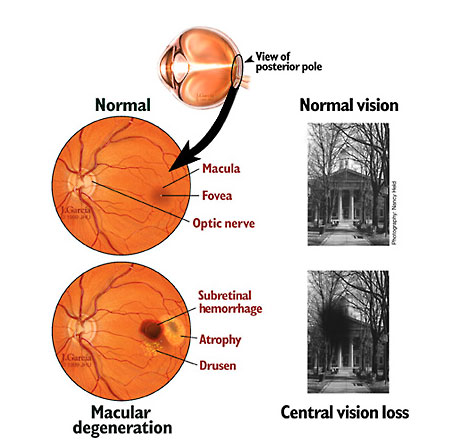
The macula is located behind the eye in the center of the retina. Although the macula makes up just 1/20 of the entire retina, it is responsible for the sharp, clear, and undistorted detail of central vision, which enables us to read, recognize faces, drive a car, and watch television.

There are two types of macular degeneration. “Dry” macular degeneration is how age-related macular degeneration starts and drusen (German for “small dots”) begin to form in the retina around the macula. It is important to note that the presence of drusen does not necessarily mean that macular degeneration will eventually occur, nor does it mean future vision loss.

dry macular degenerationHowever, if drusen continue to form, then dry macular degeneration will occur. The good news is that the progression of this form of macular degeneration is very slow and noticeable visual impairments usually do not occur for several years. However, when they do occur, the same field of vision problems that sufferers of wet macular degeneration experience will be present.

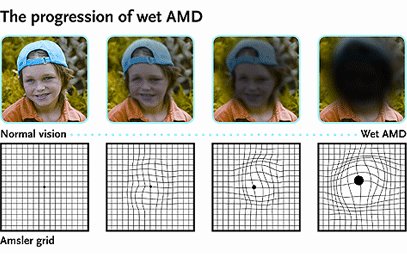
wet macular degeneration“Wet” macular degeneration, on the other hand, is more serious and can result in immediate and severe vision loss. Wet macular degeneration occurs when blood vessels burst in the retina and fluid and blood leaks result in cell death.  

While there is no treatment to reverse – although vitamin supplementation may help slow the progress – dry macular degeneration, there are very effective treatments to stop the fluid and blood leaks and prevent damage to the eye at retinal eye centers for wet macular degeneration. This is a serious vision condition that needs to be treated immediately.

This sequence of pictures and graphs (showing the distortion of central vision) shows what the progression of wet macular degeneration does to vision:

Progression of wet macular degeneration

I bring these up because my mom had dry macular degeneration in one eye (her stronger eye) and wet macular degeneration, which we treated aggressively up until her death, in the other eye (her weaker eye) before she was diagnosed with vascular dementia, Lewy Body dementia, and Alzheimer’s Disease.

And I know, with the damage to other parts of her brain from the dementias and Alzheimer’s Disease, the visual distortions caused by these common age-related vision problems were exaggerated.

It’s important to know this is not uncommon with our loved ones suffering from dementias and Alzheimer’s Disease, and is part of what makes the whole process a losing battle from the get-go.

One of the most noticeable visual distortions associated with dementias and Alzheimer’s Disease is characterized by sudden stops at door thresholds and on walking surfaces where there are delineated changes in color and consistency, such as going from a wood or tiled floor onto carpeted floor.

These are known as “visual cliffs,” and, interestingly, the same phenomenon is observed in infants as they begin to crawl. What causes these abrupt stops are abnormal depth perception and a fear of falling.

The ability to accurately perceive depth seems to erode in proportion with the increased damage to the brain caused by dementias and Alzheimer’s Disease.

An unexpected benefit of this, however, is that caregivers can use this visual distortion to help control wandering by putting “cliffs” (a two-inch piece of black tape) at the bottom of and on the thresholds of exterior doors. This is typically pretty effective.

Other common vision distortions include:

  • Illusions – what the person sees is a “distortion of reality.” This most likely occurs because of a particular characteristic of an object, such as a shiny surface or a patterned print. An example of an illusion would be seeing a face in a curtain with a pattern.
  • Misperceptions – what the person sees is a “best guess” at the inaccurate or distorted information the brain has received from the eyes. An example of this would be believing that a shadow on a sidewalk is a hole in the sidewalk.
  • Misidentifications – damage to specific parts of the brain will cause problems identifying objects and people. For example, distinguishing between a daughter or son, sister or brother, mother or father, and a spouse becomes difficult and then impossible.

If we, as loving caregivers, can better understand the what and the why of the visuoperceptive difficulties inherent in dementias and Alzheimer’s Disease, then we are better equipped to adapt our loved ones’ environments to make those environments as comfortable, as non-threatening, and as “safe” as possible. We’ll never be able to completely eliminate the effects because the diseases are bigger than our best efforts.

Some of the causes of visuoperceptive difficulties in our loved ones with dementias and Alzheimer’s Disease include:

  • decreased sensitivity to differences in contrast (including color contrast such as black and white, and contrast between objects and background)
  • reduced ability to detect movement
  • changes to the visual field (how much you can see around the edge of your vision, while looking straight ahead)
  • reduced ability to detect different colors
  • changes to the reaction of the pupil to light
  • problems directing or changing gaze
  • problems with the recognition of objects, faces and colors
  • loss of ability to name what has been seen
  • double vision

Dementias and Alzheimer’s Disease also bring difficulties with orientation. Evidence of this includes:

  • bumping into things
  • swerving to avoid door frames
  • difficulties reaching for things within the visual environment (such as a glass of water or a door handle)
  • getting lost or disorientated, even in familiar environments.

The cumulative effect of the visuoperceptual changes brought on by dementias and Alzheimer’s Disease will result in:

  • difficulty reading and writing, doing puzzles or playing board games
  • problems locating people or objects, even though they may be in front of our loved ones (this may be because of other distracting visual information, such as patterned wallpaper or curtains, or because of a lack of color contrast [for example, not being able to see mashed potatoes on a white plate])
  • misinterpretation of mirrored reflections and shadows (this can manifest itself as our loved ones seeing an intruder or refusing to go into a bathroom because reflections in the mirror make it appear occupied)
  • difficulty sitting down correctly in a chair or on the toilet
  • Confusion and/or restlessness because of an environment that is visually over-stimulating and difficult to navigate

Visuoperceptual difficulties also lead to problems moving around. These problems make our loved ones fearful of falling and, as a result, they tend to dramatically slow down their movements while they try to walk safely.

As loving caregivers, we should learn to anticipate these situations, help explain what is being encountered, offer our arms for support, offer encouragement and slow down our own movements to match those of our loved ones.

Specific difficulties that our loved ones with dementias and Alzheimer’s Disease have when moving around include:

  • misjudging distances and where objects are, even in familiar environments
  • taking very high steps over breaks in walking surfaces (from a wood or tiled floor to carpet and door thresholds, for example) or shadows because the change in color looks like a change in height
  • struggling with going down stairs because they can’t judge how many steps there are and where the next one is
  • avoiding walking on shiny floors because they appear wet or slippery.

As caregivers, we can help minimize some of the effects of visuoperceptive difficulties for our loved ones suffering from dementias and Alzheimer’s Disease in several ways.

The first way is to ensure that our loved ones get regular eye health checkups and that any age-related vision problems that can be treated are treated immediately and aggressively.

A deliberate use of colors can help with diminished contrast vision. For example, a green plate on a white tablecloth is much easier to see than a white plate on a white tablecloth. Additionally, changing from a standard white toilet seat to a colored toilet seat will make the toilet seat easier to see.

We can also use color to highlight important objects and orientation points (for example, the bathroom door).

Improving the lighting levels in our homes will also help our loved ones, and ensuring that lighting is even around the house will minimize shadows and “dark areas,” making navigation and perception easier.

Use solid colors instead of patterns in flooring, carpeting, and runners to give a safer environment for navigating the house.

If mirrors and shiny surfaces cause problems with illusions and misperceptions, then remove those that are practical to remove and cover the rest.

Be sure to close curtains or blinds at night.

How we respond to our loved ones with visuoperceptual difficulties is perhaps the most critical part, in my opinion, of showing our love for them.

I have always had a very tender and gentle side, but I never showed or saw much of it myself until I took over the responsibility from my dad of taking care of Mama and making sure she was comfortable, safe, protected and okay.

Our responses should be calm and loving always. And this can be challenging, especially when we’re tired or aggravated. I am stating an ideal that I didn’t always attain with Mama. But it’s our goal to do this.

When our loved ones don’t recognize an object or person, we should not draw attention to the mistake nor ask questions that would put our loved ones “on the spot.”

We can explain what the object is used for or who the person is, but if it doesn’t work, let it go. It’s far more important to listen to what our loved ones are saying – and encouraging them to converse and participate in activities – than it is for us to be right.

When our loved ones don’t recognize people, we can ask friends and relatives to introduce themselves to our loved ones. Not recognizing people can be very distressing for our loved ones, and it can be upsetting for the people who are no longer recognized.

However, in the end, our job is to make sure our loved ones feel safe, encouraged, and supported. This is not their fault, so criticism or trying to force them to do something they are mentally incapable of doing is cruel and will often make our loved ones retreat from interaction with us and others. That does no one any good.

Hallucinations also fall into the vision category because our loved ones often see people who are not there or people who have died as if they are alive and in the room with them. Mama saw Daddy regularly, even though when she started seeing him, he’d already been dead for ten years.

She also saw friends and family from her earlier years from time to time.

And she saw people going in and out of her apartment (usually a young boy and girl, who’d go in when she left, and leave just as she came back in) just before her psychiatric hospitalization and the subsequent diagnoses of mid-to-late-stage vascular dementia and Alzheimer’s Disease in 2010.

Most of the time, she told me about these “visits” after the fact, but two hallucinations happened with me there when she was living with me. And they floored me, but instead of insisting there was no one there, I let her talk about them, which gave me time to formulate honest answers to her questions about them without hurting her or dismissing her.

The first happened just after she’d awoken one morning and I was sitting on the bed with her holding her hand while she woke up. I was speechless when she pointed to the bookcase just to the left of the bed and she asked me, “Do you see those two angels over there?” I told her I didn’t, but I encouraged her to tell me what she was seeing. She wasn’t scared and she seemed to be happy “they” were there. 

As soon as Mama was fully awake, they were gone.

The second one was much different. We got up in the middle of the night because she needed to go to the bathroom (I kept the bathroom door fully open and a light on at night, and since it was just the two of us, I seldom closed the door). Just after she got in the bathroom with my help, she said, “Close the door! I don’t want that man to see me!”

I closed the door with both of us in there. When we were done, I opened the door to help her back to bed and she asked me if the man had gone upstairs. I nodded. She relaxed and went back to bed and back to sleep.

When she awoke the next morning, she didn’t say anything about the man right away. But when we were eating breakfast, she asked me where the man and the children – there were no kids the night before – were. I suspected she was thinking of Daddy and us as kids, so I told her everyone was gone and just the two of us were there at home.

That ended it, but it didn’t end the hallucinations that I continued to hear about right up until her death.

I was initially very conflicted about how to respond to Mama about the hallucinations because I knew they weren’t real and I believed I would be dishonest if I gave any indication that I thought they were.

However, I realized the hallucinations were real to her, even if I knew they weren’t really happening, so I encouraged her to talk about them in a way that didn’t lead her to ask me questions because I wasn’t sure how to answer them.

And I found that to be the best approach. She wasn’t afraid, she didn’t shut down, and she didn’t feel threatened by my response. And I heard some pretty interesting stories in the process. It was win-win.

My next post will tackle some of the psychoses that our loved ones suffer with dementias and Alzheimer’s Disease. While not all of these are negative – I will give some specific examples – many of them are and they, in my opinion, are one of the toughest aspects of these diseases to deal with rationally, lovingly, and calmly.

But it can be done and I will pass on some tips and lessons I learned in the process in the hope that it will help you.

The Layperson’s Guide to Alzheimer’s Disease

Today’s post will provide an overview look at Alzheimer’s Disease. As I’ve stated before, Alzheimer’s Disease is a specific type of brain deterioration disease (dementia) that differs from other dementias.

While Alzheimer’s Disease is a type of dementia, not all dementias are Alzheimer’s Disease. “Alzheimer’s Disease” has become the catch-phrase for all neurological degeneration among the general population and that imprecision leads to a lack of understanding of the complexities of these diseases, especially when several types of dementia are present concurrently.


Dementias affect specific areas of the internal structure of the brain and are caused by specific abnormal occurrences within those areas. We’ve looked at vascular (multi-infarct) dementia, which is a result of small vessel ischemia within the blood vessels in the brain, and Lewy Body dementia, which occurs when abnormal proteins are deposited in the cortex of the brain.

Plaques and Tangles in Alzheimer's DiseaseAlzheimer’s Disease affects the whole brain, essentially eroding and diminishing, through the resulting atrophy, the whole structure of the brain. The two crucial components in Alzheimer’s Disease are the overabundant presence of plaques (beta-amyloid protein deposit fragments that accumulate in the spaces between neurons) and tangles (twisted fibers of disintegrating tau proteins that accumulate within neurons). Watch this short video to see how these plaques and tangles form and how they lead to neuron death.

While plaques and tangles, which lead to neuron death (the nerve cells get deprived of what they need to survive and be healthy), are part of the aging process, in our loved ones with Alzheimer’s Disease, there are so many of them that the brain slowly dies from the inside out.

Healthy Brain vs Alzheimer's Disease Brain

It is clear from the picture above exactly why Alzheimer’s Disease is a systemic disease, because all areas of the brain are eventually impacted.

However, as Alzheimer’s Disease begins, the first area of the brain affected is the temporal lobe, which is, in part, responsiblelobes of brain for long and short-term memory, and persistent short-term memory loss is usually one of the first symptoms of Alzheimer’s Disease to appear.

The second area of the brain to be affected is generally the frontal lobe, which handles information processing and decision-making. The last part of the brain to be affected is usually the parietal lobe, which is the area of the brain responsible for language and speech.

Alzheimer’s Disease has distinct stages in which symptoms materialize. The stages are (this lists the three main stages, but there is also a more comprehensive seven-stage breakdown, known as the Global Deterioration Scale or the Reisberg Scale):

  • Stage 1 – Mild – Recurring short-term memory loss, especially of recent conversations and events. Repetitive questions and some trouble with expressing and understanding language. Possible mild coordination problems with writing and using objects. May have mood swings. Need reminders for some daily activities, and may begin have difficulty driving.
  • Stage 2 – Moderate/Middle – Problems are evident. Continual memory loss, which may include forgetting personal history and the inability to recognize friends and family. Rambling speech. Unusual reasoning. More confusion about current events, time, and place. Tends to get lost in familiar settings. Experiences sleep issues (including sundowning). More pervasive changes in mood and behavior, especially when experiencing stress and change. May experience delusions, aggression, and uninhibited behavior. Mobility and coordination may be affected. Need set structure, reminders, and assistance with daily living.
  • Stage 3 – Severe/Late – Confused about past and present. Loses all ability to remember, communicate, or process information. Generally incapacitated with severe to total loss of verbal skills. Unable to care for self. Often features urinary and bowel incontinence. Can exhibit extreme mood disturbances, extreme behavior, and delirium. Problems with swallowing occur in this stage as well.

It’s important to remember that not all our loved ones with Alzheimer’s Disease – especially if there are other dementias present – will go through every aspect of each stage nor through all the stages before they die. That’s one of the real difficulties with “mixed-dementia” diagnoses, as these are called, because it’s difficult to tell which brain disease is causing which problems and that makes them more difficult to manage symptom-wise.

The medications generally prescribed for Alzheimer’s Disease are Aricept (mild to moderate stages), Namenda (moderate stage), and Excelon (mild to moderate). All three of these medications are cognitive enhancers. It’s not unusual to have more than one of these medications prescribed at a time.

I will talk specifically about sleep disturbances in dementias and Alzheimer’s Disease, including sundowning, in another post, but I will caution all caregivers to stay away from both non-prescription sleep medications like Tylenol PM, Advil PM, and ZZZQuil and prescription sleep medications like Lunesta and Ambien (all of these can actually make the symptoms worse and definitely make injury and/or death from a fall more likely).

Melatonin is naturally-occurring sleep hormone in humans. As people age, there is less melatonin produced. That’s why, in general, most older people who have never had sleep disorders eventually and gradually sleep less than their younger counterparts. However, the brain damage that dementias and Alzheimer’s Disease cause exacerbates this lack of melatonin. 

So, it’s worth it to try a therapeutic dose (up to 20 mg per night is considered to be safe) of Melatonin. It is available over-the-counter at both brick-and-mortar and online drug stores.

Start with a 3 mg dose and add slowly. With my mom, a 5 mg dose provided enough for her to sleep as best as she could through the night. Do not overdose because this will disrupt the circadian rhythm further by producing late sleeping and grogginess during the day.

Usually our loved ones with dementia and/or Alzheimer’s Disease, even though these diseases are fatal (when the brain’s dead, you’re dead), don’t die from them specifically.

They die either from a concurrent health problem (in my mom’s case, it was congestive heart failure which lead to a major heart attack, a minimal recovery, and then her death twelve days later) or from complications that arise from the brain degeneration caused by the dementias and/or Alzheimer’s Disease.

The two most common causes of death in Alzheimer’s Disease are pneumonia (the brain controls swallowing, and once that becomes compromised, aspiration of food into the lungs is likely and leads to an infection) and fatal trauma to the head from falls.

The Layperson’s Guide to Lewy Body Dementia

Today’s post will discuss Lewy Body dementia: what it is, some of the hallmark features of it, and medications that can help, unless there are severe side effects, and some alternatives to deal with those cases in which the most-often prescribed medications may not work.

Lewy Body dementia is diagnosed during life by its symptoms. The only way to Lewy Body Proteinconfirm it medically is by doing an autopsy on the brain after death. However, the symptoms are obvious enough that it can easily be diagnosed while our loved ones are alive.

This history of  discovering the source of Lewy Body dementia began with Frederick Lewy in 1912. While doing autopsies on the brains of people who’d been diagnosed with Parkinson’s Disease (Lewy Body dementia and Parkinson’s Disease share many motor systems characteristics), Lewy discovered tiny – and abnormal – protein deposits in deteriorating nerve cells of the mid-brain. These proteins became known as Lewy Bodies. Their presence in the mid-brain always leads to a diagnosis of Parkinson’s Disease.

It wasn’t until fifty-plus years later that scientific researchers discovered these same abnormal protein deposits in the cortex (the “gray matter”) region of the brain in patients who had suffered from dementia.

Someone with Lewy Body dementia will have these abnormal protein deposits in both the mid-brain and the cortex. 

The symptoms that differentiate Lewy Body dementia from Parkinson’s Disease are:

  • Vivid and recurring hallucinations and delusions early on when the inkling that something’s going wrong starts.
  • REM sleep behavior disorder
  • Mild to moderate motor skills impairment, most notably with balance, muscle stiffness, and the tendency to fall frequently. A shuffling gait when walking is usually noticeable as the disease progresses.
  • Strong and dramatic fluctuations in cognitive function and alertness.

With my mom, although Lewy Body dementia wasn’t officially diagnosed (I did the research on what I was seeing and realized that’s what it was) until near the end of her life, all three of these symptoms were present early on when I realized something was wrong. She had progressively-worse balance problems the last six years of her life, with those becoming a front-and-center issue in 2010 when she began falling a lot.

Her hallucinations and delusions became a centerpiece issue in 2010 as well. There were also some fluctuations in her cognitive function in 2010, but the strong and dramatic fluctuations in both cognitive function and alertness did not begin until December of 2011. Even then, they were sporadic, but fairly quickly became more of a mainstay until her death in August 2012.

One the medications that she was given during her psychiatric hospitalization in 2010 was SeroquelXR.

This is one of the drugs you’ll have to make a judgment call on, since there are risks and potentially dangerous side effects to use this medication for an “off-label” use in treating the symptoms of dementias and Alzheimer’s Disease.

SeroquelXR is an anti-psychotic (neuroleptic) medication specifically developed for bipolar disorder. It carries a warning that it is not be used in elderly patients with dementia. Additionally, among our loved ones suffering from Lewy Body dementia, about 50% have adverse reactions to neuroleptic medications.

However, for Mom, it worked very well for about sixteen months in controlling the hallucinations and the delusions. In late November 2011, Mom woke up one morning and her whole body was uncontrollably, but rhythmically spasming. She wasn’t in any pain, but she was scared, so I had EMS get her to the emergency room so we could find out what was going on. What she experienced was late-stage neuroleptic-induced tardive dyskinesia.

The SeroquelXR was the culprit, so the neurologist discontinued that during her hospital stay and the spasms stopped within a few days. I was concerned about the mood aspect of not having the SeroquelXR, so the neurologist and Mom and I discussed options, since she was on anti-anxiety medication already.

The best and most workable solution was Depakote, a medication typically prescribed for epilepsy sufferers. It would work on both mood and spasms, but the neurologist said the hallucinations and delusions were going to come back.

And within a month, they did, but they were not scary to Mom and they were always a surprise to me, even though I expected them, but not unpleasant and not unmanageable.

But I came to realize that the SeroquelXR had effectively controlled a lot of the Lewy Body dementia symptoms the longer that Mom was off of it, because after the SeroquelXR was discontinued, the Lewy Body dementia symptoms gradually increased and worsened.

So SeroquexXR can be very effective in treating the symptoms as long as our loved ones can tolerate it and don’t have the kind of problems Mom experienced with tardive dyskinesia.

And that is an important point to make. A lot of this becomes a judgment call on our part as advocates and caregivers for our loved ones. If I knew back in 2010 (I wasn’t involved in the prescription part when Mom was critical and hospitalized) what I know now about SeroquelXR, I would have agreed to it. Because for sixteen months, it gave Mom a pretty decent quality of life in the dementias and Alzheimer’s Disease realm.

There is no known cause for Lewy Body protein deposits occurring in the mid-brain and cortical regions of the brain, so there’s nothing health-wise or lifestyle-wise that can be done to prevent it.

But, if we can understand what it looks like, then we can help keep our loved ones more comfortable and safe and perhaps keep ourselves a little saner and a little calmer. The more we know, the better we can love and serve them.

I’ll end this post with a progressive-over-time brain scan image of Lewy Body dementia (the source is http://www.neurology.org/). A picture sometimes is worth one thousand words, especially when I consider the fact that my mom had vascular dementia, Lewy Body dementia, and Alzheimer’s Disease and this picture shows the damage to the brain from just one of those three diseases. What an uphill battle her last few years were and she fought it bravely and well right up to the end.

Progression of Lewy Body Dementia

The Layperson’s Guide to Vascular Dementia, Multi-Infarct Dementia, Small Vessel Ischemia, and TIA’s

There are many kinds of dementia. In the next few posts, we’ll take a look at a few of them, along with Alzheimer’s Disease, which is a distinct neurological diagnosis from dementias.

Before we start, it is important to note that our loved ones can suffer from only Alzheimer’s Disease or only one kind of dementia. Or they may suffer from Alzheimer’s Disease and multiple kinds of dementia. That distinction is important to loving caregiving, which includes medical advocacy for our loved ones, because each brain disease is distinct, affects the brain differently, and has specific characteristics and symptoms and treatment.

I will admit here that one of my pet peeves while caring for my mom was hearing some people who have no real knowledge of these diseases lump everyone who suffers from them under Alzheimer’s Disease and giving advice on how to deal with that, not realizing the complexity of the situation posed by the presence of both dementias and Alzheimer’s Disease.

So, for non-caregivers or those who are unfamiliar and inexperienced with these diseases who may be reading this, please don’t assume because you’ve seen or read The Notebook that you’re an expert on the subject and please don’t offer medical diagnoses and advice.

The best gift you can give is to just listen and offer non-medical support. Most caregivers get so deep into the details and all the aspects of these diseases because they need to be able to take care of their loved ones in so many ways that if there were such a thing as a non-M.D. expert on them, most caregivers would qualify.

This post will discuss vascular (multi-infarct) dementia. The cause of this dementia is small vessel ischemia in the brain, which presents itself as chronic transient ischemic attacks (TIA’s). TIA’s are sometimes also referred to as mini-strokes.

TIA’s can occur when the small vessels in the brain get temporarily blocked, cutting off the blood supply and oxygen to that part of the brain. The cumulative affect of these is what causes the damage that is present in vascular dementia. Multi-infarct dementia just means that there are many areas in the brain where this vascular damage has occurred and accrued.

Although high blood pressure is a culprit, high levels of stress and a history of migraines are also players in these kind of TIA’s.

In my mom’s case, all three were factors, but high levels of stress were what brought on the majority of her TIA’s. I suspect she started having these as a small child, because there were times that she just couldn’t remember what happened in a specific instance but she’d referred to it as “blacking out.”

She never lost consciousness with them that I witnessed, but she used the same expression to describes times when we kids were all babies and she was under a lot of stress and she couldn’t remember certain instances of things.

Her TIA’s were common as we grew up, and although we never got over the shock of the suddenness of symptoms and the helplessness we had to do anything about it, we all got pretty good at taking care of her when she had one, and that lasted for Daddy until his death, and for me into adulthood until Mama’s death.

Her TIA’s always presented the same way. They were sudden. Her face would lose all color and her lips would get very pursed as she seemed to salivate more. There was a sort of paralysis except for her right hand. She would start rubbing her thumb across the first two fingers and that would last until the episode was over. I suspect there was a sense of unreality associated with the TIA, so the feeling of her fingers rubbing together was the only reality for her in those episodes.

I’d always hold Mama’s left hand and kind of stroke it so she knew I was there and she wasn’t alone. When the TIA was over, she’d immediately try to talk and everything came out totally garbled. That would last about thirty minutes and then she’d be okay.

And she never remembered them happening. I remember the first time I was giving her medical history as her POA at an ER (and this was way before the dementias and Alzheimer’s Disease) and I named TIA’s as part of her medical history and she disagreed with me and said she didn’t remember ever having those. I laughed at the time and told her that not remembering them was part of the symptom of having them.

small-vessel-ischemia-brain-mriOver time, though, as small vessel ischemia recurs, eventually clusters of damage occur in the brain. This disrupts the normal neurological pathways of how information is learned and communicated. One of the most clear indicators of vascular dementia is difficulty in communication. One of these difficulties is misnaming things.

For example, the brain knows that a pencil is a pencil. Someone suffering from vascular dementia knows a pencil is a pencil. But because of the damaged pathways, there is often a break in the connection between knowledge and speech, so someone with vascular dementia is just as likely to call a pencil an apple.

Another clear indicator of vascular dementia is slower processing time. A brain with vascular dementia will fight to reroute stored information to speech. However, because of the extensive damage, it has to take a much more convoluted and lengthier route to do that conversion.

A third clear indicator of vascular dementia is that it occurs in sudden, steep steps of decline (brought on by recurrent TIA’s and new clustered areas of damage in the brain). These can occur in a very short period of time, as they did in my mom’s case.

In addition to these definitive indicators, vascular dementia also has features in common with other dementias, including difficulty learning anything new, cognitive impairment, problems with short-term memory, extreme emotional swings, and confusion.

There are no specific treatments for vascular dementia. Unlike any other organ in the body, once the brain has sustained damage, that damage is permanent.

However, there are medications that can address the symptoms of vascular dementia. The two most likely to help are cognitive enhancers: Excelon (although this comes in oral form, the 24-hour patch is best, if there’s no allergic reaction, to get the continual effect of medication that comes in a starting dose of 4.6 mg, a stabilizing dose of 9.5 mg, and a high dose at 13.3 mg)  and Namenda (given in 5 mg increments, two to three times a day).

When I discuss the medications in later posts, I will give some practical experience and advice on these two medications, especially with regard to Medicare, the “donut hole,” and working with your loved one’s psychiatrist to get the medication at either no charge or a reduced rate during the “donut hole” period. Both of these are patented, so there’s no cheaper generic version. And paying full price for them will break the bank.

In the next post, we’ll take a look at Lewy Body dementia: what is is, how it’s diagnosed, what it looks like, and effective treatments for the symptoms.