Tag Archive | Alzheimer’s Disease, Dementias, Age-Related Illnesses Caregiver Support

Experiencing Dementias and Alzheimer’s Disease From the Inside

I recently watched The Iron Lady, the 2011 movie in which Meryl Streep portrayed Margaret Thatcher, the late Prime Minister of Great Britain. I think everyone ought to see this movie, not so much for the historical content, but to experience from the inside what our loved ones with dementias and Alzheimer’s Disease experience.

According to Mrs. Thatcher’s daughter, Carol, her battle with dementia and/or Alzheimer’s disease became noticeable in 2000 and The Iron Lady focuses on the years after the death of her husband, Dennis, in 2003.

I cannot adequately express how much insight and understanding experiencing this – and I literally felt like I was experiencing it – gave me into what Mom went through.

I also cannot begin to convey the deeper empathy, Margaret Thatcher, Prime Minister, Great Britain, The Iron Ladysympathy, and protectiveness that I experienced as well. There were many moments when I wished I could take both Mrs. Thatcher and Mom into my arms and just hold them tight and not let go.

This movie touched my heart on its deepest levels and my tears and my helplessness welled up deep within me. And, yet, it looked like – and explained – a lot of what I saw, from the outside, with Mom.

I remember the first time Mom told me that Daddy, who’d been dead for ten years, had visited her the night before and that he’d left right before I got there. Mrs. Thatcher spent a lot of time with Dennis, as the dementia/Alzheimer’s Disease progressed, after his death as well.

There is a frenetic and frenzied scene in which, in an attempt to banish Dennis for good, Mrs. Thatcher packs everything of his up in a few short hours, including a suitcase for him. He takes the suitcase and leaves for good while she is begging him not to leave just yet. It’s a very poignant scene.

One of the brilliant aspects of this movie is that it captures the mental confusion and chaos of dementias and Alzheimer’s Disease. We experience it right along with Mrs. Thatcher. And it made sense to me because it explained a lot of what I had seen with Mom. Interestingly, it didn’t bother me nor did it seem weird to me. It looked a lot like what I already knew.

But the difference was that I was finally able to walk in Mom’s shoes and know how she experienced it. That made me love her even more – if that’s possible – and it made me wish I’d known then what I know now. But maybe I can take what I learned and, as always, pay it forward.

Sundowning and the Sleep Conundrum of Dementias and Alzheimer’s Disease

Today’s post will discuss how dementias and Alzheimer’s Disease affect circadian rhythms and sleep, as well as some tips to help manage sleep disruptions effectively.

There are a lot of factors that make up our sleep behavior. I first want to discuss the biology of sleep and how, even if there are no other sleep disorders, dementias and Alzheimer’s Disease disrupt the biological sleep cycle.

Normal Circadian RhythmHumans have an internal 24-hour clock that is synchronized with daytime and nighttime (light has a profound impact on this clock). This clock is referred to as our circadian rhythm.

As people age, this clock changes so that they normally tend to go to sleep earlier and wake up earlier. Sleep disorders like insomnia and sleep apnea are more common in older people as well. But their circadian rhythms are still primarily based on light (the more light, the more wakefulness; the less light, the more sleepiness) and time of day.

However, in our loved ones suffering from dementias and Alzheimer’s Disease, circadian rhythms go out the window because the diseases impair the brain’s ability to tell time and to distinguish between light and dark as indicators of when to sleep and when to awaken. It is sometimes helpful, in the early stages, to get a 24-hour clock to help our loved ones distinguish between A.M. hours and P.M. hours, but eventually that will be a casualty of the diseases.

The most common circadian rhythm disorder associated with dementias and Alzheimer’s Disease is a phenomenon known as “sundowning.” It occurs in the late afternoon and early evening.

It is characterized by speech and behavior repetition, constant pacing , excessive restlessness, wandering, disorientation to time and place, and agitation or aggression towards others.

Wandering is especially dangerous because if our loved ones get outside, they can walk long distances with limited vision because of the sun going down, sometimes on crowded roadways, and are susceptible to being the victims of crime and vehicular death.

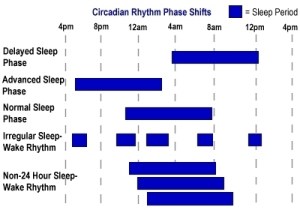
One probable cause of sundowning is that there is damage to the part ofSleep/Wake Patterns Circadian Rhythm the brain that produces melatonin (the sleep hormone) and the reduced production causes an irregular sleep-wake rhythm
Another theory on the cause of sundowning is related to the energy levels of our loved ones with dementias and Alzheimer’s Disease . At the end of the day they are likely tired from the day’s activities.

This can aggravate the symptoms of the diseases, making them more anxious and stressed. Before the onset of these diseases, this time of day would have typically been the busiest for them. They would be getting home from work, getting ready for dinner, doing household chores, and going to bed. Now that they’re unable to do those things, they have little to do at a time that was the busiest of the day for them.

The most common sleep disorder that occurs with dementias and Alzheimer’s Disease is an irregular sleep-wake rhythm. You can see in the graph above how disruptive this rhythm is and why our loved ones with dementias and Alzheimer’s can be so tired, in general, all the time.

However, I believe the most damaging effect of this sleep pattern is that it actually prevents the restorative/repair functions that occur during a normal sleep rhythm, which exacerbates the neurological damage that dementias and Alzheimer’s Disease do to the brain. In short, this sleep pattern makes the diseases worse.

The most effective – and safe – way to try to minimize an irregular sleep-wake rhythm is to add melatonin to nighttime medications. As I’ve said before, up to 12 mg of melatonin is considered safe, but start with a low dose (3 mg or 5 mg) and give it time to see if that gives our loved ones more continuous and restful sleep. The goal is to keep them asleep at night and keep them awake during the day. Too much melatonin can have them sleeping all the time.

I would also suggest keeping our loved ones active and busy – as they are able – during the day (I will talk more about this in another post, but will briefly touch on it here). Up until the last week and a half of my mom’s life, when she’d had the major heart attack and just couldn’t do much with me, I had her help me with the household chores that she could like making the bed, folding laundry, preparing meals, and helping me with the dishes.

I didn’t care whether it was perfect or not (initially a big challenge to my normal OCD about those kinds of things), but I found that the more she did, the better she felt and the better she slept.

There is a sleep disorder that is specific to Lewy Body dementia and is one of the primary symptoms of that form of dementia. It is called R.E.M. sleep behavior disorder.

R.E.M. sleep behavior disorder is impossible to miss. Anytime a sufferer is asleep, they are in motion acting out their dreams and, at least in my mom’s case, having sometimes understandable and sometimes not in-depth conversations. It is also characterized by “picking” at clothing or bedclothes while asleep.

On the one hand, at least for me, it was quite fascinating to watch Mom dream and act out her dreams. Apparently – and I’ve seen this with other Lewy Body dementia sufferers, so it must be common for all of us to dream about – she dreamed quite often about food, because she’d often make the motion of either eating with a utensil or with her hands to her mouth. That was usually when she was napping during the day. 

Most of her conversations occurred at night, although occasionally she’d say a line or two during a daytime nap. And they’d last all night sometimes.

Her nightime dreams also included a lot of moving around and possibly a version of restless legs syndrome (not uncommon for R.E.M. sleep behavior disorder).

While I know this had a detrimental effect on her quality of sleep, it was disruptive for me too. I have always been a light sleeper and have had my own issues all my life with not sleeping much (and sometimes not sleeping at all for a day or two) and not getting quality sleep (waking up a lot or being wide awake in the early morning hours and not being able to go back to sleep for an hour or two). With Mom talking and moving around all night, it made sleep that much more difficult for me.

An increase in melatonin helped with this as well. I bumped her up to 7 mg each night (she was at 5 mg before) and it was just enough to keep most of the symptoms at bay. There were still some nights when it was noticeable, but the worst of the symptoms seemed to be alleviated. And because she slept better, she felt better and did better during the daytime.

I hope this brief overview helps. If you have any questions or any topics you would like to see discussed here, leave me a comment or email me at goinggentleintothatgoodnight.com. If I don’t know the answer, I’ll do my best to try to find it.

You’re not alone and my intent and goal is to keep reminding you of that and help you as much as I am able.

“Fields of Gold: A Love Story” Published and Available for Purchase

My memoir about my parents – who were both orphaned at very young ages – and their life together, which included adopting my sisters and me, and then Mama’s journey to the end last August, Fields of Gold: A Love Story, has been published and is now available for purchase.

Watch the publication announcement video to put some faces with the posts I write here, including that of my beautiful Mama.

I wrote this memoir in about six weeks just after Mama died, first to preserve our family stories for my sisters and me and her grandchildren, but then it evolved into a full-length book that chronicled our lives from beginning to end – at least for my parents – and I hope will live on as a tribute to their legacy and a reminder to each of us of the legacy we are now responsible for carrying on and passing on to the next generations.

The Layperson’s Guide to Medications and Vitamins Relating to Dementias and Alzheimer’s Disease

This post will be a comprehensive list – in one place – of the prescription medications and vitamins that may be prescribed for our loved ones suffering from dementias and Alzheimer’s Disease.

My main purpose in doing this is so that caregivers, as medical advocates for our loved ones, have the information needed about the common medications and vitamins used to treat the symptoms of these diseases. 

Currently there is a lot of information on the internet about these, but it’s so scattered and oftentimes so clinically-written that it’s impossible to pull it all together and make wise decisions as to accepting or rejecting medication proposals from primary care physicians and psychiatrists.

And the preceding paragraph has some information caregivers need to know, exercise, and require for their loved ones.

First, both a primary care physician and a psychiatrist need to be involved in medical care for our loved ones. One of the first requests that should be made to the primary care physician after a dementias and/or Alzheimer Disease diagnoses should be a referral to a geriatric psychiatrist.

The reason caregivers need to do this is because geriatric psychiatrists specialize in treating elderly patients and they also have access to the latest research in the treatment of the symptoms of dementias and Alzheimer’s Disease.

Primary care physicians are not specialists. This includes internists. They know a little bit about a lot of things, which is exactly what they were trained for (and that’s not a bad thing), but they don’t have the time nor the resources to be experts in any one thing.

Therefore, a geriatric psychiatrist is an absolute necessity to ensure our loved ones get the best care possible to treat the symptoms of these diseases.

Second, you have the right to refuse medication. For example, one of the medications that Mom’s primary care physician wanted to give her as the Lewy Body dementia symptoms worsened was Abilify. No doubt you’ve all seen the commercials touting Abilify as a “booster” for use with anti-depressants to relieve chronic depression.

This is an “off-label” use of the drug. So is prescribing it for our loved ones with dementias and Alzheimer’s Disease (a lot of the mood and psychosis-managing drugs prescribed for people suffering from dementias and Alzheimer’s Disease are “off-label” uses of those drugs).

I did the homework on it before I filled the prescription. Ability was created to treat schizophrenia. That would have probably been okay, but then I saw the warning that “ABILIFY (aripiprazole) is not approved for the treatment of people with dementia-related psychosis.”

In addition, by then I knew Mom also had Lewy Body dementia in addition to vascular dementia and Alzheimer’s Disease and I knew about the increased neuroleptic sensitivity associated with Lewy Body dementia, so I didn’t fill the prescription.

Prescriptions Dementia Alzheimer's DiseaseThe first category of prescription medications is the cognitive enhancers. These drugs are designed to maintain mental health and may improve memory, awareness and the ability of our loved ones to go about their daily activities by boosting the function of existing neurotransmitters involved in memory and judgment in the brain. They will not reverse nor stop the neurological course of the diseases. They are:

  • Aricept – Approved for all stages of dementias and Alzheimer’s Disease, but most effective in mild to moderate stages
  • Razadyne – Mild to moderate stages of dementias and Alzheimer’s Disease
  • Excelon – Mild to moderate stages of dementias and Alzheimer’s Disease
  • Namenda – Moderate to severe stages of dementias and Alzheimer’s Disease

The second category of prescription medications treats the mood and psychosis symptoms of dementias and Alzheimer’s Disease.

These medications need to be closely monitored and carefully dosed.

The optimal result of these medications is mood stabilization and no psychosis. If your loved ones are “knocked out” by this category of medications, the doses are too high. If your loved ones are “out of control,” the doses are too low. This is another reason you want a psychiatrist involved.

There are many possible combinations of this category of drugs. All the anti-psychotic drugs have possible side effects and extreme caution should be exercised, because of the high sensitivity to neuroleptics,  in using these with our loved ones with Lewy Body dementia. Some of the most commonly-used medications are:

  • SeroquelXR – anti-psychotic (possible side effects of neuroleptic sensitivity and tardive dyskinesia in Lewy Body dementia)
  • Citalopram – anti-depressant
  • Clonazepam – anti-anxiety

Anti-anxiety medications seem to be the most frequently mismanaged in this category of drugs. My advice is to advocate with our loved ones’ psychiatrists for low dosages and have them prescribe it to be taken as-needed instead of as part of the daily medication regimen.

The medication, Halcyon, by the way, should be avoided at all costs in people suffering from dementias and Alzheimer’s Disease. It really wreaks havoc and it has a very long half-life! The most likely place this would be given is during hospitalizations, so be sure to let all the hospital staff you come in contact with know that our loved ones should not be given Halcyon for anxiety and/or sleep.

vitamins for dementia and Alzheimer's DiseaseVitamin supplements may be added to address some of the functioning difficulties brought on by dementias and Alzheimer’s Disease. In my personal experience, I really don’t believe they’re all that effective after the fact of diagnosis. However, we all should make sure we have plenty of this in our own diets now to protect ourselves.

The most common are:

  • Folic acid – helps memory and mental processing speed
  • Vitamin D3 – protects the brain by controlling neurotransmitters and clearing amyloid plaques (found in Alzheimer’s Disease)
  • Vitamin C – protects cells from the effects of free radicals
  • Melatonin – facilitates sleep

Please be careful to work with your loved one’s primary care physician on vitamin supplementation. In many instances, these brain diseases are not the only health issues our loved ones are dealing with and some of the vitamins that might address dementia and Alzheimer’s Disease symptoms could negatively interact with other prescription medication for other health problems.

Our job as loving caregivers is to give the best care we are able to our loved ones, advocating for them, protecting them, making sure that everything that is being done is in their best interests.

We are there because we love them.

All the other participants in the caregiving journey are there for other reasons and those reasons may, intentionally or unintentionally, not consider what is best for our loved ones.

So it’s our job to make sure that we are the gatekeepers to the best care we are able to provide for the people we love. It’s a big responsibility, but, in my opinion, there is no greater gift we can give or be given in this life than to do this.

Reminder About “Going Gentle Into That Good Night” on Amazon

I’m working on a couple of posts, but I went in for a full eye exam this morning and they dilated both eyes and I can barely see to type. 🙂

So, since I’m unable to finish the posts I’m working on today, I’d like to thank everyone who is following this blog. I’d also like to remind you that Going Gentle Into That Good Night is available on Amazon.com (there are print and Kindle versions).

And if you find the information here useful and helpful, I would sure appreciate it if you’d consider a small donation (there’s a PayPal button on the left menu). All donations will be used to continue to provide practical and loving caregiving for our loved ones with dementias and Alzheimer’s Disease.

Be sure, if you haven’t subscribed to email updates, to do so. Every time I update the site, you’ll get an email notification. I’m planning on incorporating different kinds of media here (nope, you won’t see me or hear me…and that’s a good thing, trust me!) because I believe that sometimes a picture is – or pictures are – really worth a thousand words.

Hope you have a good weekend and looking forward to being back with you more regularly next week!

The Layperson’s Guide to Alzheimer’s Disease

Today’s post will provide an overview look at Alzheimer’s Disease. As I’ve stated before, Alzheimer’s Disease is a specific type of brain deterioration disease (dementia) that differs from other dementias.

While Alzheimer’s Disease is a type of dementia, not all dementias are Alzheimer’s Disease. “Alzheimer’s Disease” has become the catch-phrase for all neurological degeneration among the general population and that imprecision leads to a lack of understanding of the complexities of these diseases, especially when several types of dementia are present concurrently.


Dementias affect specific areas of the internal structure of the brain and are caused by specific abnormal occurrences within those areas. We’ve looked at vascular (multi-infarct) dementia, which is a result of small vessel ischemia within the blood vessels in the brain, and Lewy Body dementia, which occurs when abnormal proteins are deposited in the cortex of the brain.

Plaques and Tangles in Alzheimer's DiseaseAlzheimer’s Disease affects the whole brain, essentially eroding and diminishing, through the resulting atrophy, the whole structure of the brain. The two crucial components in Alzheimer’s Disease are the overabundant presence of plaques (beta-amyloid protein deposit fragments that accumulate in the spaces between neurons) and tangles (twisted fibers of disintegrating tau proteins that accumulate within neurons). Watch this short video to see how these plaques and tangles form and how they lead to neuron death.

While plaques and tangles, which lead to neuron death (the nerve cells get deprived of what they need to survive and be healthy), are part of the aging process, in our loved ones with Alzheimer’s Disease, there are so many of them that the brain slowly dies from the inside out.

Healthy Brain vs Alzheimer's Disease Brain

It is clear from the picture above exactly why Alzheimer’s Disease is a systemic disease, because all areas of the brain are eventually impacted.

However, as Alzheimer’s Disease begins, the first area of the brain affected is the temporal lobe, which is, in part, responsiblelobes of brain for long and short-term memory, and persistent short-term memory loss is usually one of the first symptoms of Alzheimer’s Disease to appear.

The second area of the brain to be affected is generally the frontal lobe, which handles information processing and decision-making. The last part of the brain to be affected is usually the parietal lobe, which is the area of the brain responsible for language and speech.

Alzheimer’s Disease has distinct stages in which symptoms materialize. The stages are (this lists the three main stages, but there is also a more comprehensive seven-stage breakdown, known as the Global Deterioration Scale or the Reisberg Scale):

  • Stage 1 – Mild – Recurring short-term memory loss, especially of recent conversations and events. Repetitive questions and some trouble with expressing and understanding language. Possible mild coordination problems with writing and using objects. May have mood swings. Need reminders for some daily activities, and may begin have difficulty driving.
  • Stage 2 – Moderate/Middle – Problems are evident. Continual memory loss, which may include forgetting personal history and the inability to recognize friends and family. Rambling speech. Unusual reasoning. More confusion about current events, time, and place. Tends to get lost in familiar settings. Experiences sleep issues (including sundowning). More pervasive changes in mood and behavior, especially when experiencing stress and change. May experience delusions, aggression, and uninhibited behavior. Mobility and coordination may be affected. Need set structure, reminders, and assistance with daily living.
  • Stage 3 – Severe/Late – Confused about past and present. Loses all ability to remember, communicate, or process information. Generally incapacitated with severe to total loss of verbal skills. Unable to care for self. Often features urinary and bowel incontinence. Can exhibit extreme mood disturbances, extreme behavior, and delirium. Problems with swallowing occur in this stage as well.

It’s important to remember that not all our loved ones with Alzheimer’s Disease – especially if there are other dementias present – will go through every aspect of each stage nor through all the stages before they die. That’s one of the real difficulties with “mixed-dementia” diagnoses, as these are called, because it’s difficult to tell which brain disease is causing which problems and that makes them more difficult to manage symptom-wise.

The medications generally prescribed for Alzheimer’s Disease are Aricept (mild to moderate stages), Namenda (moderate stage), and Excelon (mild to moderate). All three of these medications are cognitive enhancers. It’s not unusual to have more than one of these medications prescribed at a time.

I will talk specifically about sleep disturbances in dementias and Alzheimer’s Disease, including sundowning, in another post, but I will caution all caregivers to stay away from both non-prescription sleep medications like Tylenol PM, Advil PM, and ZZZQuil and prescription sleep medications like Lunesta and Ambien (all of these can actually make the symptoms worse and definitely make injury and/or death from a fall more likely).

Melatonin is naturally-occurring sleep hormone in humans. As people age, there is less melatonin produced. That’s why, in general, most older people who have never had sleep disorders eventually and gradually sleep less than their younger counterparts. However, the brain damage that dementias and Alzheimer’s Disease cause exacerbates this lack of melatonin. 

So, it’s worth it to try a therapeutic dose (up to 20 mg per night is considered to be safe) of Melatonin. It is available over-the-counter at both brick-and-mortar and online drug stores.

Start with a 3 mg dose and add slowly. With my mom, a 5 mg dose provided enough for her to sleep as best as she could through the night. Do not overdose because this will disrupt the circadian rhythm further by producing late sleeping and grogginess during the day.

Usually our loved ones with dementia and/or Alzheimer’s Disease, even though these diseases are fatal (when the brain’s dead, you’re dead), don’t die from them specifically.

They die either from a concurrent health problem (in my mom’s case, it was congestive heart failure which lead to a major heart attack, a minimal recovery, and then her death twelve days later) or from complications that arise from the brain degeneration caused by the dementias and/or Alzheimer’s Disease.

The two most common causes of death in Alzheimer’s Disease are pneumonia (the brain controls swallowing, and once that becomes compromised, aspiration of food into the lungs is likely and leads to an infection) and fatal trauma to the head from falls.

You Will Never Be the Same Again

Caring for a loved one with dementias and Alzheimer’s Disease changes us. This, I believe, is one of the most unrecognized aspects of going through the journey of these diseases with loved ones.

I know with my mom, who had vascular dementia, Lewy Body dementia, and Alzheimer’s Disease as well as suffering from congestive heart failure, I changed throughout the course of our journey together, perhaps as much or more, in different ways, as she did. 

And now that she’s gone, it’s difficult for me to imagine that person that I was before all this started. That person in that configuration is gone. In some ways, that’s good, because that previous iteration of me had some flaws that needed mending, ideas that needed changing, and attitudes that needed correction.

In other ways, though, it’s challenging. Caregiving is a 24/7 job, especially as the diseases progress and the changes become more rapid and more intense, requiring every bit of time, effort, and diligence on our parts to ensure our loved ones are safe and comfortable.

Because of the nature of dementias and Alzheimer’s Disease, this is a long, extended high-alert, always-alert, always-ready position for caregivers. It becomes who we are and it reflects the tenor of our lives.

And then one day, it suddenly stops. Adjusting to that abrupt and radical change is, in my opinion, of all the things caregivers do in the course of taking care of loved ones, the hardest part.

I think of it as being in a car going from 120 mph to a dead stop within the time it takes to snap your finger. In some ways, it’s like the aftermath of a high-impact car crash that you walk away from.

I have learned, though, that unless you’ve walked in the shoes of caregiving day in and day out for someone you love with dementias and/or Alzheimer’s Disease, it’s very hard to relate to what the now-defunct caregiver is going through in this post-caregiving phase. It’s not that other people don’t want to understand. It’s just that they can’t really if they haven’t been through it.

There is a tremendous sense of being lost. Because loving caregiving requires such a high investment all the way around, when that ends, there’s a sense of purpose, usefulness, and worth that ends with it.

There’s a sense of wandering around aimlessly while the rest of the world around you is going on as it always has. There is a sense of not belonging anywhere, to any time, or any place. It seems like no matter what you do after that, it’s meaningless, compared to what you were able to give your loved one.

My guess is that will be something we carry somewhere inside us the rest of our lives. It’s just part of the change.

Another change will be that you’re more observant and helpful, especially around elderly folks. Not long ago, I volunteered to help during a cookout at a rehabilitation hospital. One of the things I was doing was helping people to the tables, some of which were on concrete and some of which were on grass.

There was an elderly woman with a walker who clearly had balance issues, and although there were staff members around, no one seemed to realize that as she was walking on the sidewalk toward a table in the grass, she was precariously close to the curb and all it would have taken is just a second for her to have lost her balance, fallen and hurt herself. Visions of Mom flashed in my brain and I ran over to help make sure she got where she was going safely.

Greater compassion toward and protectiveness of those who are vulnerable, as our loved ones suffering from dementias and Alzheimer’s Disease are, will be another change that occurs.

A friend of mine who works as a beautician in a senior care facility wrote on FacebookChange the other day about getting cursed out by an 88-year-old woman who didn’t want the shampoo rinsed out of her hair.

Almost immediately, the insensitive and disrespectful comments started. One person said that she would have sprayed the elderly lady in the face if she had cursed at her.

I got very angry. That could have been my mama they were talking about. I sent a private message to my friend explaining that the lady probably had some form of dementia and/or Alzheimer’s Disease and didn’t even know what she was doing and would have probably, given her age, never done that in her right mind. 

And the biggest change will be that your life will never be the same. You will never look at anything the way you looked at it before you embarked on the caregiving journey with your loved one. At a core level, you’ve changed.

And your biggest challenge will be figuring out what to do with that to go forward, to make the experience count, not just for your loved one, but everyone else, in whatever small way you can, that your life intersects with until the day that you draw your last breath.

And you’ll find it’s a very solitary, lonely journey. But like all the journeys you’ve been on up until now, it’s a necessary one. It will take a lot of patience and gentleness with yourself. It will take time. Most of it will be arduous.

But the most important thing I can pass on to you is not to quit and keep putting one foot in front of the other, even if for long stretches it seems you’re walking in place. Sooner or later, as long as you’re moving, eventually it will be in forward motion. 

Going Gentle Into That Good Night Blog

After publishing Going Gentle Into That Good Night, I have given a lot of thought about how to best provide on-going and more detailed practical help and information about loving caregiving for our loved ones with dementias and Alzheimer’s Disease.

I intentionally wrote the book to be read quickly and to give immediate, big-picture information to caregivers.

However, there are a lot of details and little things that will come up along the way. There is a lot of information that can take hours of research to find and put together to evaluate a new or sudden situation or a change in behavior, actions, etc. There are many practical matters and considerations that take time and energy that you won’t necessarily have that need to be addressed.

Based on some of the messages I’ve gotten so far, there’s a real need for a blog like this. And it gives me a chance to continue in my parents’ footsteps of paying forward. In every thing that I have done since Mama died, that’s been the intent behind it. To step into the shoes of my parents’ legacy and leave the world a better place than I found it. Just like they did.

So, my intention with this blog is to give you as much information in one place as I can to help you do what’s most important: loving and practical caregiving.

So follow the blog and we’ll walk through the journeys together. Please comment or if there’s something you’d like to discuss privately, you can email me at goinggentleintothatgoodnight@gmail.com.

And, for those who are inclined, I’ve included a Donate button on this blog. It’s optional, but anything given will be used to continue to educate and help in every way that I am able anybody and everybody who is caregiving (not just dementias and Alzheimer’s, although that will be a strong focus of this blog) for elderly loved ones.

Thanks and welcome aboard!


“Going Gentle Into That Good Night” on Amazon.com

“Going Gentle Into That Good Night” on Amazon.com

I’m creating this blog to continue to provide practical information related to the loving care of our loved ones with all types of dementia and Alzheimer’s Disease.

I decided this was the best way to get salient information out quickly and also to answer questions as they have been coming in since the publication of Going Gentle Into That Good Night.