Profiles in Dementia: Helen French Garrison (1930 – 2017)


Helen Garrison as a young womanOne of my best and closest friends, who is a sister to me and I to her, lost her mom, Helen French Garrison, to dementia on Sunday, January, 29, 2017.

While my friend shares many traits and characteristics with her dad, she shares just as many with her mom, including, to name a few, her mom’s Southern charm, her grace, her kindness, and her generosity.

Helen Garrison was a beautiful lady inside and out. I’m thankful that both Mama and I had the honor of calling her both family and friend.

In tribute to Helen, and with the family’s permission, this profile in dementia is written by my friend about her mom and her dad, who faithfully and lovingly kept his in-sickness-and-in-health promise as Helen’s primary caregiver during her long journey through dementia, and their lives together as husband and wife.
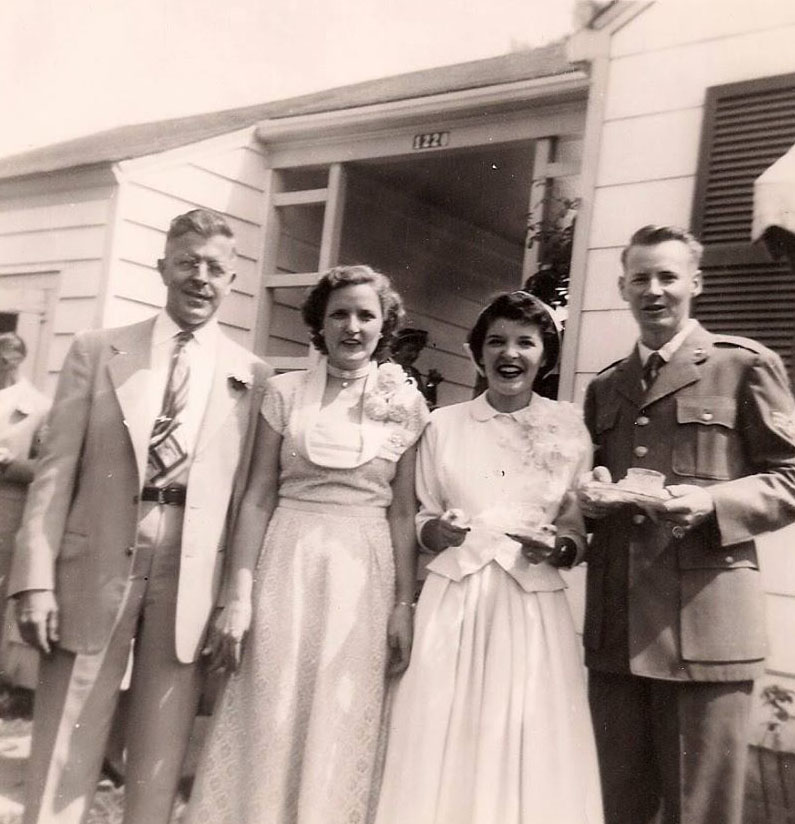
Lloyd Helen Garrison wedding day“I’ve always been so thankful for the blessing of my devoted, loving, godly parents. And this week I’m thankful to have been with them for the final days of my mother’s life. In the past few days my dad has been recalling and sharing so many stories and memories of their life together. They were a very special couple who worked together to keep their promise of for better or worse, til death. Together they brought up two children and are the grandparents of six and great grandparents of nine. Now my dad is trying to figure out where to go from here. After 64 ½ years of marriage, he has to change his mindset from “we” to “I” – quite a challenge for him at age 87.

My mother was born February 20, 1930 in Bethlehem, Pennsylvania. At the age of twelve, she moved with her parents and sister Blondie to Sheffield, Alabama where she finished her schooling. In 1952 she graduated with every honor from Florence State Teachers College, now the University of North Alabama, with a teaching degree.

Three months later she married Lloyd Garrison, and they moved to Cheyenne, Wyoming where he was stationed at the Air Force Base. When he was discharged, they returned home to Alabama where my brother and I grew up.

Mother taught elementary school for decades and was much loved by her students and their parents. After retiring from teaching, she ran the office for the very busy Garrison Electric Company which my dad started. She was energetic and full of life, love, and joy which she radiated to her family, students and friends. Also, she was an amazing hostess and cook, and she thrived on having groups of friends and family over for meals and fun. She hosted many family Thanksgiving, Mother’s and Father’s Day and anniversary events! For our pre-wedding dinner for family and wedding party members, she killed, skinned, and cooked a dozen chickens in addition to all the side dishes and dessert!

Interestingly, my mother’s many strengths and talents were my dad’s growth or challenge areas, and conversely, my dad’s many outstanding talents were my mother’s growth areas. They relied on each other, and together they made the complete package!

Lloyd and Helen Garrison in their golden yearsOf course this is a bittersweet time for our family — the bitterness of the loss and void, and the sweetness that finally Mother is at peace, no longer struggling and suffering. We are focusing on the many cherished memories of life with such an outstanding loving and beautiful lady. And we rely on our faith in the promises of God that we will see her again.

Helen French Garrison died on January 29, 2017.”

Antidepressant Use and the Increased Risk of Developing Dementia

The Link Between Antidepressants and Dementia is Becoming More EvidentSeveral studies released recently – here we will focus on two of them: one a two-year study with a large group of elderly (over 65 years of age) participants and the a broader study tracking neurological changes associated with dementia that included participants of all ages – have raised significant red flags about the use of antidepressants and the increased risk of dementia associated with that. Continue reading

Book Review: “He Wanted The Moon: The Madness and Medical Genius of Dr. Perry Baird, and His Daughter’s Quest to Know Him” – Mimi Baird

He Wanted the Moon: The Madness and Medical Genius of Dr. Perry Baird, and His Daughter's Quest to Know HimHe Wanted the Moon: The Madness and Medical Genius of Dr. Perry Baird, and His Daughter’s Quest to Know Him by Mimi Baird
My rating: 5 of 5 stars

This book will break your heart in a lot of ways, but I highly recommend it.

Mimi Baird’s father mysteriously disappeared from her life at age 6 without any real explanation from anyone, including her mother, as to why. The oldest of the three Baird children, Mimi had the only vivid memories of her dad, of their connection, and, subsequently, she alone felt and mourned his sudden absence the most. Continue reading

A Force Was With Us and What A Force She Was – Carrie Fisher (1956 – 2016)

Carrie FisherAlthough this post may not seem relevant on a blog devoted to caregiving and the myriad aspects and factors that come into play in the development of dementias and Alzheimer’s Disease, I assert that, in many ways, it is entirely appropriate.

It serves as both a cautionary tale, which Fisher herself told in many ways and many times over the course of the last 30 or so years, and as a fond goodbye to a lady, who despite her many mistakes and many flaws, has left a legacy of character traits to respect. Continue reading

Good Sleep: A Key Factor in Neurological Health

How much sleep and the quality of that sleep plays a key role in the health of the brainSleep – how much and the quality of it – has a profound and lifelong impact on the brain. When we get enough sleep and that sleep is deeply restful, the brain does beneficial housecleaning that sweeps away the toxins and waste products that accumulate in the spaces between brain cells during our waking hours.

Many of these toxins, including the beta amyloid proteins associated with Alzheimer’s Disease, if not removed, are directly responsible for neurological damage and decline, resulting in eventual cognitive impairment and dementia. Continue reading

The Layperson’s Guide to Primary Progressive Aphasia (PPA)

Neurological distribution of primary progress aphasia (PPA)Primary progressive aphasia (PPA) is a neurological effect specifically associated with certain types of dementia (Alzheimer’s Disease and frontotemporal dementia are the most common underlying forms of dementia in which PPA occurs) that results in linguistic abilities becoming slowly and progressively impaired until they are completely gone.

Continue reading

Daylight Savings Time and Its Effects on Health, Sleep, and Our Loved Ones with Dementias and Alzheimer’s Disease

Daylight Savings Time Increases Health Risks Physically and NeurologicallyHere in the United States, most of the country ended Daylight Savings Time (DST) at 2:00 a.m. on Sunday, November 5, 2016, which moved our clocks back an hour.

Both the beginning and end of DST are tough changes on even the healthiest among us. For someone like me who has had hardwired sleep challenges all my life, both the beginning and end of DST are particularly hard for me for about a week until my body and brain adjust to the change. Continue reading

Profiles in Dementia: Robin Williams (1951 – 2014)

Robin Williams in "Good Morning, Vietnam"Robin Williams was a man of great intellectual depth and many diverse talents. He burst on the scene as the quirky, but engaging Mork on the TV series Mork and Mindy in the late 1970’s. It was clear even then that his talent was bigger than the small screen could contain, and he quickly made the transition to the big screen in films that brought him great acclaim (Dead Poet’s SocietyAwakeningsGood Morning, Vietnam, and What Dreams May Come, to name a few) as a serious actor, writer, and producer. 

Williams, a graduate of Julliard, began his career as a stand-up comedian. His style was unique: rapid-fire, insightful, and always extremely funny with the undercoating of serious truths lying just beneath the humor.

Early in Williams’ career, he battled the same demons of drug and alcohol abuse that seem to disproportionately haunt the most talented among us mere mortals. He successfully overcame both, but I am inclined to believe that the years of substance abuse were a contributing factor to his development of Lewy Body dementia in the couple of years of his life.

Williams’ widow, Sharon Schneider Williams, recently wrote an essay (published in the official journal of the American Academy of Neurology) describing her husband’s last year as Lewy Body dementia consumed his brain.

Robin Williams in his last year of lifeIt is hard at times to read (I saw many things there that I saw in my own mom’s Lewy Body dementia), but it captures the essence of Lewy Body dementia in real time in a way I have not seen described before.

Robin Williams, unable to continue to humanly fight the unseen, but increasingly-threatening terrorist that had permanently taken his brain hostage, took his own life on August 11, 2014.

Profiles in Dementia: Charmian Carr (1942 – 2016)

Charmian Carr as Liesl in 1965's "Sound of Music"Charmian Carr was born in 1942 to parents who were performing artists (her mother was a vaudeville actress and her father was an orchestra leader) and she followed in their footsteps in her early life, landing the role of Liesl Von Trapp at 21 in Sound of Music in 1965.

Although Carr had a lauded role in the classic film and the promise of a good career as an actress – her only other film was with Anthony Perkins in 1966’s musical Evening Primrose – Carr made the choice to pursue a more private life.

She married, raised two daughters, and ran her own design business.

However, Carr happily embraced her role in the Sound of Music throughout her life, writing two books – Being Liesl and Letters Charmian Carrto Liesl – about the lasting effect of her seminal character on her own life and participating in singalong performances of the Sound of Music soundtrack at the Hollywood Bowl.

Before a 2005 performance at the Hollywood Bowl, Carr
commented: “I tell people that they should consider singalong Sound of Music like going to a therapist. It’s just a kind of therapy. They can move around. They can dance and talk back to the screen. They can skip their appointment with the shrink that week.”

Carr died on September 19, 2016 at the age of 73 from an undisclosed rare form of dementia.


The Neurological Legacy of 9/11 on First Responders: PTSD, Cognitive Impairment, and Dementia

9/11/01 Collapse of Tower 2 of the World Trade CenterWhile most reports on the long-term health effects on first responders to the terrorist attack on September 11, 2001 at the World Trade Center in New York City have focused on physical damage – increased rates of severe respiratory conditions and incidences of cancer – often leading to premature death, it has only been within the last month that the long-term neurological effects have been examined and documented. Continue reading